

Introduction
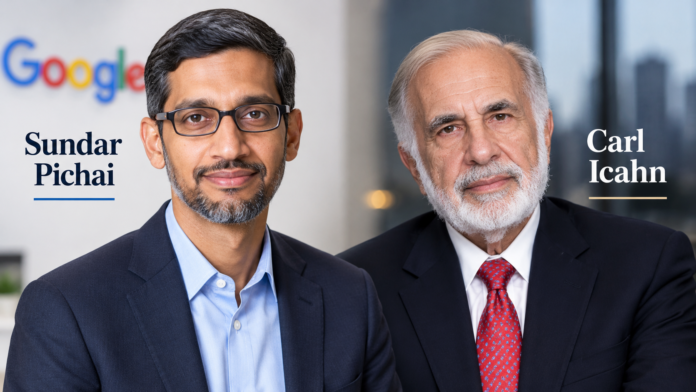
Sundar Pichai and Carl Icahn are two influential names in the American business world, but they represent very different approaches to success. Sundar Pichai is known for leading Google and its parent company, Alphabet, through major technological changes, including the growth of artificial intelligence, cloud computing, and digital services. Carl Icahn, on the other hand, is a billionaire investor recognized for his aggressive investment strategies, shareholder activism, and efforts to influence the direction of major corporations.
Although their careers developed in different industries, both men have played important roles in shaping modern business. Pichai has helped guide one of the world’s most widely used technology companies, while Icahn has built a reputation for challenging corporate leadership and pushing businesses to reconsider their strategies. Their professional journeys offer valuable lessons about leadership, financial decision-making, and the different ways individuals can influence large organizations.
People searching for Sundar Pichai and Carl Icahn may be interested in their backgrounds, careers, net worth, leadership styles, and possible business connections. It is important to clarify that they are not primarily known for a direct personal or professional partnership. Instead, their significance comes from their separate achievements and the contrasting roles they represent in the global economy.
Who Is Sundar Pichai?
Sundar Pichai and Carl Icahn Pichai, whose full name is Pichai Sundararajan, is an Indian-born American business executive who serves as the CEO of Google and Alphabet. He became Google CEO in 2015 and took on the leadership of Alphabet, Google’s parent company, in 2019. Under his leadership, Google has continued developing products and services used by billions of people, including Google Search, Chrome, Android, Gmail, Google Maps, and Google Cloud.
Pichai was born and raised in Chennai, India, where he developed an interest in technology and engineering. He studied metallurgical engineering at the Indian Institute of Technology Kharagpur before moving to the United States for further education. He earned a master’s degree from Stanford University and an MBA from the Wharton School at the University of Pennsylvania. His educational background helped prepare him for a career that would combine technical understanding with business management.
Before joining Google, Pichai worked at Applied Materials and the management consulting firm McKinsey & Company. He joined Google in 2004 and gradually took on greater responsibilities within the organization. His work on Google Toolbar and Google Chrome helped establish his reputation as a product-focused leader. Over time, he moved into broader executive roles, eventually becoming responsible for the company’s overall direction. His career demonstrates how technical knowledge, product development, and strategic thinking can combine to create opportunities for leadership.
Sundar Pichai’s Rise to Leadership at Google
Pichai’s career at Google advanced as the company expanded beyond its original search engine business. He played a significant role in the development and growth of Google Chrome, a browser that became a major part of the company’s digital ecosystem. Chrome helped connect users with Google Search, online services, and web-based applications, strengthening Google’s position in the global internet market.
As his responsibilities increased, Pichai took on leadership of major products and platforms, including Android, Chrome, and Google’s applications. These products serve different purposes, but they are connected through a broader ecosystem that supports mobile devices, web browsing, communication, productivity, and online information. Coordinating such a wide range of products requires an understanding of both technology and consumer behavior.
In 2015, Pichai became CEO of Google, and in 2019, he became CEO of Alphabet as well. These appointments placed him in charge of a large organization with interests spanning advertising, cloud computing, consumer devices, online video, and advanced research. His leadership has involved balancing established revenue sources with investments in emerging technologies. As artificial intelligence becomes more central to Google’s products, Pichai faces the challenge of maintaining the company’s competitive position while addressing questions about reliability, privacy, safety, and responsible innovation.
Who Is Carl Icahn?
Carl Icahn is an American investor and businessperson widely recognized for his role in shareholder activism. Unlike executives who lead a company through day-to-day operations, Icahn has often sought to influence corporate decisions by acquiring significant ownership stakes and pressing management teams to make changes. His investment career has involved companies across industries such as energy, transportation, manufacturing, real estate, and consumer products.
Icahn was born in New York City and grew up in Far Rockaway, Queens. He graduated from Princeton University in 1957 with a degree in philosophy and later attended medical school at New York University before leaving that path. He entered the financial industry in 1961 and established Icahn & Co. in 1968. His early work included securities trading, arbitrage, and options, providing a foundation for the investment strategies he developed in later decades.
During the late 1970s and the following decades, Icahn became known for taking substantial positions in companies and seeking changes that he believed could increase shareholder value. These efforts sometimes involved challenging boards, influencing management decisions, restructuring businesses, or advocating for transactions involving company assets. His approach has attracted both supporters and critics. Supporters view activist investors as a force that can hold management accountable, while critics argue that certain activist strategies may place short-term financial returns ahead of a company’s long-term interests.
Sundar Pichai and Carl Icahn: Careers, Wealth, and Business Influence
Introduction
Sundar Pichai and Carl Icahn are two influential names in the American business world, but they represent very different approaches to success. Sundar Pichai and Carl Icahn Pichai is known for leading Google and its parent company, Alphabet, through major technological changes, including the growth of artificial intelligence, cloud computing, and digital services. Carl Icahn, on the other hand, is a billionaire investor recognized for his aggressive investment strategies, shareholder activism, and efforts to influence the direction of major corporations.
Although their careers developed in different industries, both men have played important roles in shaping modern business. Pichai has helped guide one of the world’s most widely used technology companies, while Icahn has built a reputation for challenging corporate leadership and pushing businesses to reconsider their strategies. Their professional journeys offer valuable lessons about leadership, financial decision-making, and the different ways individuals can influence large organizations.
People searching for Sundar Pichai and Carl Icahn may be interested in their backgrounds, careers, net worth, leadership styles, and possible business connections. It is important to clarify that they are not primarily known for a direct personal or professional partnership. Instead, their significance comes from their separate achievements and the contrasting roles they represent in the global economy.
Who Is Sundar Pichai?
Sundar Pichai and Carl Icahn Pichai, whose full name is Pichai Sundararajan, is an Indian-born American business executive who serves as the CEO of Google and Alphabet. He became Google CEO in 2015 and took on the leadership of Alphabet, Google’s parent company, in 2019. Under his leadership, Google has continued developing products and services used by billions of people, including Google Search, Chrome, Android, Gmail, Google Maps, and Google Cloud.
Pichai was born and raised in Chennai, India, where he developed an interest in technology and engineering. He studied metallurgical engineering at the Indian Institute of Technology Kharagpur before moving to the United States for further education. He earned a master’s degree from Stanford University and an MBA from the Wharton School at the University of Pennsylvania. His educational background helped prepare him for a career that would combine technical understanding with business management.
Before joining Google, Pichai worked at Applied Materials and the management consulting firm McKinsey & Company. He joined Google in 2004 and gradually took on greater responsibilities within the organization. His work on Google Toolbar and Google Chrome helped establish his reputation as a product-focused leader. Over time, he moved into broader executive roles, eventually becoming responsible for the company’s overall direction. His career demonstrates how technical knowledge, product development, and strategic thinking can combine to create opportunities for leadership.
Sundar Pichai’s Rise to Leadership at Google
Pichai’s career at Google advanced as the company expanded beyond its original search engine business. He played a significant role in the development and growth of Google Chrome, a browser that became a major part of the company’s digital ecosystem. Chrome helped connect users with Google Search, online services, and web-based applications, strengthening Google’s position in the global internet market.
As his responsibilities increased, Pichai took on leadership of major products and platforms, including Android, Chrome, and Google’s applications. These products serve different purposes, but they are connected through a broader ecosystem that supports mobile devices, web browsing, communication, productivity, and online information. Coordinating such a wide range of products requires an understanding of both technology and consumer behavior.
In 2015, Pichai became CEO of Google, and in 2019, he became CEO of Alphabet as well. These appointments placed him in charge of a large organization with interests spanning advertising, cloud computing, consumer devices, online video, and advanced research. His leadership has involved balancing established revenue sources with investments in emerging technologies. As artificial intelligence becomes more central to Google’s products, Pichai faces the challenge of maintaining the company’s competitive position while addressing questions about reliability, privacy, safety, and responsible innovation.
Who Is Carl Icahn?
Carl Icahn is an American investor and businessperson widely recognized for his role in shareholder activism. Unlike executives who lead a company through day-to-day operations, Icahn has often sought to influence corporate decisions by acquiring significant ownership stakes and pressing management teams to make changes. His investment career has involved companies across industries such as energy, transportation, manufacturing, real estate, and consumer products.
Icahn was born in New York City and grew up in Far Rockaway, Queens. He graduated from Princeton University in 1957 with a degree in philosophy and later attended medical school at New York University before leaving that path. He entered the financial industry in 1961 and established Icahn & Co. in 1968. His early work included securities trading, arbitrage, and options, providing a foundation for the investment strategies he developed in later decades.
During the late 1970s and the following decades, Icahn became known for taking substantial positions in companies and seeking changes that he believed could increase shareholder value. These efforts sometimes involved challenging boards, influencing management decisions, restructuring businesses, or advocating for transactions involving company assets. His approach has attracted both supporters and critics. Supporters view activist investors as a force that can hold management accountable, while critics argue that certain activist strategies may place short-term financial returns ahead of a company’s long-term interests.
Sundar Pichai’s Leadership Style and Business Strategy
Sundar Pichai and Carl Icahn Pichai is often associated with a collaborative and product-focused leadership style. His career suggests that understanding users and improving products can be just as important as making large business decisions. Rather than building his reputation through public confrontations, he has generally focused on developing technology, coordinating teams, and guiding Google’s long-term strategy.
One of his biggest responsibilities has been helping Google respond to rapid technological changes. Artificial intelligence has become increasingly important to online search, productivity tools, cloud services, and software development. Under Pichai’s leadership, Google has invested in AI research and integrated AI capabilities into more of its products. These changes reflect the company’s effort to remain competitive as users explore new ways to find information and complete tasks.
However, leading a company of Google’s size also involves significant challenges. Competition, regulatory scrutiny, privacy concerns, and questions about the effects of AI all influence its business decisions. Pichai must balance innovation with responsible development while ensuring that Google’s established services continue to serve users effectively. His leadership illustrates the complexity of managing a technology company whose products affect businesses, governments, and individuals worldwide.
Carl Icahn’s Investment Strategy
Carl Icahn built his reputation through an investment approach known as shareholder activism. This strategy involves purchasing significant stakes in companies and using shareholder rights to encourage changes that the investor believes will improve business performance or increase the value of an investment. Such changes may involve corporate governance, leadership decisions, asset sales, financial restructuring, or broader business strategy.
Icahn often looks for companies that he believes are undervalued relative to their assets, earnings potential, or future prospects. Rather than simply purchasing shares and waiting for the market to recognize their value, he may engage directly with company management and boards of directors. Depending on the situation, these efforts can include negotiations, public campaigns, proxy contests, or proposals for major corporate changes. His investment philosophy emphasizes accountability and the possibility of improving businesses through active involvement. SEC
This strategy has made Icahn one of the most recognizable figures in activist investing. Supporters argue that investors like him can challenge ineffective management and encourage companies to use their resources more efficiently. Critics, however, question whether some activist campaigns place too much emphasis on immediate financial returns. The long-term effect depends on the specific company, the changes proposed, and how those changes affect employees, customers, shareholders, and future investment.
Carl Icahn’s Major Investments and Business Interests
Throughout his career, Icahn has been involved with companies in a wide range of industries. His investment history includes major businesses associated with telecommunications, energy, manufacturing, entertainment, and consumer products. These investments demonstrate his willingness to examine opportunities across different sectors rather than limiting himself to one type of business.
His investment activities have included well-known companies such as Apple, eBay, Netflix, Motorola, and Dell. His involvement has varied by company and period, so appearing on a list of his historical investments does not necessarily mean that he currently owns a stake in every business mentioned. This distinction is important when researching his investment history because holdings can change over time.
Icahn Enterprises has served as his principal publicly traded holding company, with interests across multiple operating businesses and investments. The company describes its strategy as identifying undervalued businesses and seeking to improve their value through active involvement, operational changes, or acquisitions. This approach reflects Icahn’s belief that ownership can provide opportunities to influence how a business is managed and developed. SEC
Sundar Pichai and Carl Icahn: Are They Connected?
A common question behind the keyword Sundar Pichai and Carl Icahn is whether the two business figures have a direct professional relationship. Their careers have attracted attention for different reasons, but their established public biographies do not identify a notable personal partnership or a major joint business venture between them.
Pichai leads Google and Alphabet, focusing on technology development, product strategy, business operations, and the company’s long-term direction. Icahn is primarily known for investment management and shareholder activism, through which he seeks to influence businesses in which he holds significant financial interests. Their professional responsibilities therefore differ considerably, even though both operate within the wider American corporate environment.
Their names may appear together in online searches because they represent two influential aspects of modern business: executive leadership and investor activism. Nevertheless, a shared appearance in a search result does not establish that they have worked together or been involved in the same corporate campaign. Without reliable evidence of a specific transaction or partnership, it is more accurate to examine their careers separately and compare their business philosophies.
Comparing Sundar Pichai and Carl Icahn’s Leadership Styles
One of the most interesting differences between Pichai and Icahn is how each approaches business influence. Pichai’s role requires him to manage a large technology organization, set priorities, oversee product development, and coordinate teams responsible for complex services. His decisions can affect the direction of Google Search, Android, Google Cloud, YouTube, and other parts of the company’s business.
Icahn’s influence generally comes from his position as an investor and shareholder activist. Rather than managing every aspect of a company directly, he can seek changes through ownership rights, negotiations, and pressure on corporate boards. His approach is more confrontational than the traditional executive model when he believes management decisions are damaging shareholder value.
Neither approach guarantees success in every situation. A technology CEO must make decisions about products and investments whose results may take years to become clear, while an activist investor must determine whether proposed changes can produce sustainable value. Both approaches involve risk, difficult judgments, and the challenge of understanding what will benefit a business over the long term.
Sundar Pichai and Carl Icahn: Net Worth and Financial Success
Sundar Pichai and Carl Icahn have achieved substantial financial success through very different professional paths. Pichai’s compensation has included executive pay and equity awards connected to his leadership positions at Google and Alphabet. His financial interests are therefore closely linked to executive compensation arrangements and the performance of the company.
Icahn’s wealth, by contrast, has largely been associated with his investments, ownership interests, and business activities. His financial position can be influenced by changes in the value of his holdings, market conditions, company performance, and the results of investment decisions. Because he has operated across several industries, assessing his wealth involves more than looking at the performance of a single company.
It is important to remember that net worth estimates published online are not the same as verified cash balances. Wealth calculations can change as stock prices move, private assets are revalued, and financial obligations change. Readers should consult reputable financial publications for current estimates and should treat specific figures cautiously when they are not supported by reliable disclosures. The two men’s financial success also cannot be compared fairly without considering the different sources of their wealth and the risks associated with their careers.
Lessons Entrepreneurs Can Learn From Sundar Pichai and Carl Icahn
Pichai’s career offers a valuable lesson about the importance of developing expertise before moving into senior leadership. His experience in engineering, product management, and business strategy helped prepare him for increasingly complex responsibilities at Google. Entrepreneurs can apply a similar principle by understanding their products, listening to customers, and learning how different parts of a business work together.
Icahn’s career highlights the importance of examining financial performance rather than accepting a company’s public image at face value. His investment strategy involves looking for differences between what a business may be worth and what the market appears to recognize. Although individual investors should not automatically copy his approach, they can learn the value of researching financial statements, understanding risks, and evaluating how management decisions affect a company’s long-term prospects.
Both careers also demonstrate that successful decision-making requires patience and adaptability. Technology businesses must continually respond to new products, changing customer expectations, and emerging competitors. Investors must adjust their strategies as market conditions and business fundamentals change. For entrepreneurs, the practical lesson is to remain informed, evaluate evidence carefully, and avoid assuming that one successful strategy will work in every situation.
The Influence of Technology Leaders and Activist Investors on the Economy
Technology leaders such as Pichai influence the economy by overseeing products and services that businesses and individuals use every day. Google’s search engine helps people discover information, Android supports a large mobile ecosystem, and Google Cloud provides computing services to organizations. Investments in AI and other emerging technologies can also influence how businesses work and how people interact with digital tools.
Activist investors such as Icahn influence the economy in a different way. By acquiring ownership stakes and advocating for changes, they can affect corporate governance, investment priorities, company structures, and decisions about how capital is used. These efforts can sometimes encourage companies to address operational problems or reconsider strategies that investors believe are ineffective.
Both types of influence come with responsibilities. Technology companies must consider privacy, competition, security, and the wider effects of their products. Activist investors must assess whether their proposed changes create lasting value rather than simply improving short-term financial results. Understanding these different responsibilities helps explain why both corporate executives and influential investors play important roles in the modern economy.
Frequently Asked Questions About Sundar Pichai and Carl Icahn
1. Who is Sundar Pichai?
Sundar Pichai and Carl Icahn Pichai is an Indian-born American business executive who serves as CEO of Google and Alphabet. He joined Google in 2004, helped lead the development of Google Chrome, and became Google CEO in 2015. He later assumed the role of Alphabet CEO in 2019. American Academy of Arts and Sciences
2. Who is Carl Icahn?
Carl Icahn is an American investor and businessman best known for shareholder activism. He has invested in companies across multiple industries and is associated with Icahn Enterprises, a diversified holding company. His approach often involves seeking changes that he believes can improve a company’s value or performance. Carl Icahn
3. Are Sundar Pichai and Carl Icahn business partners?
There is no widely documented evidence establishing a major direct business partnership between Pichai and Icahn. They are known for different professional roles: Pichai leads Google and Alphabet, while Icahn focuses on investment management and shareholder activism.
4. How did Sundar Pichai become successful?
Pichai developed a foundation in engineering and business before joining Google in 2004. He gained recognition through his work on products such as Chrome and later took on leadership responsibilities across Google’s major platforms. His progression to CEO reflects years of experience in product development, management, and corporate strategy.
5. What is Carl Icahn best known for?
Icahn is best known for purchasing significant stakes in companies and pushing for corporate changes. His activities have included challenging management decisions, advocating for changes in corporate governance, and seeking ways to increase shareholder value.
6. Who is wealthier, Sundar Pichai or Carl Icahn?
A reliable comparison requires current net worth estimates from reputable financial sources. Their wealth comes from different sources, with Pichai’s financial interests associated with executive compensation and equity awards and Icahn’s wealth linked primarily to investments and business ownership. Estimates can change significantly with market conditions.
Conclusion
Sundar Pichai and Carl Icahn represent two distinct forms of influence in the business world. Pichai has built his career around technology leadership, product development, and guiding Google and Alphabet through major changes in the digital economy. Icahn has established his reputation as an activist investor who seeks to influence corporate decisions and improve the value of selected investments.
Although they are known for different professional approaches, both careers demonstrate the importance of strategic thinking, careful decision-making, and understanding how organizations create value. Pichai’s work highlights the opportunities and responsibilities associated with leading a global technology company, while Icahn’s investment history illustrates how shareholders can influence corporate direction.
For readers researching Sundar Pichai and Carl Icahn, the key point is that their connection is primarily a comparison of two influential business figures rather than an established personal partnership. Understanding their individual backgrounds, leadership styles, and professional achievements provides a more accurate and useful picture of their impact on the modern business world.
You May Also Read: Christian Bale and Noah Centineo