
The Star Wars timeline can feel confusing at first. There are movies, animated series, live-action shows, spin-offs, and stories that jump backward and forward across different periods of the galaxy’s history. If you watch everything based only on release date, you may understand the story, but you will not always experience events in the order they actually happen.
That is why a chronological Star Wars timeline is so useful. It puts the major stories in the order they happen inside the Star Wars universe, beginning thousands of years before the Skywalker saga and moving through the rise and fall of the Jedi, the Galactic Empire, the New Republic, and later events. It also makes it easier to understand how characters, planets, and major conflicts connect.
In this guide, we will break down the Star Wars timeline in a simple way. The main focus is the current canon timeline, while also explaining where the movies and major television series fit. If you are new to Star Wars or simply want to watch the saga in chronological order, this guide gives you a clear starting point.
What Is the Star Wars Timeline?
The Star Wars timeline is the chronological order of events within the fictional galaxy. It is different from the order in which Star Wars Timeline Wars movies and shows were released. For example, Star Wars: Episode IV – A New Hope was released first in 1977, but its story takes place after The Phantom Menace, Attack of the Clones, and Revenge of the Sith.
Star Wars commonly uses the Battle of Yavin as a reference point. You may see dates written as BBY and ABY. BBY means “Before the Battle of Yavin,” while ABY means “After the Battle of Yavin.” The Battle of Yavin is the major event involving the destruction of the first Death Star in A New Hope.
There is also an important distinction between canon and Legends. Canon refers to the current official continuity used for modern Star Wars storytelling. Legends contains many older books, comics, games, and other stories that were previously part of the expanded universe but are no longer part of the main official continuity.
Star Wars Timeline at a Glance
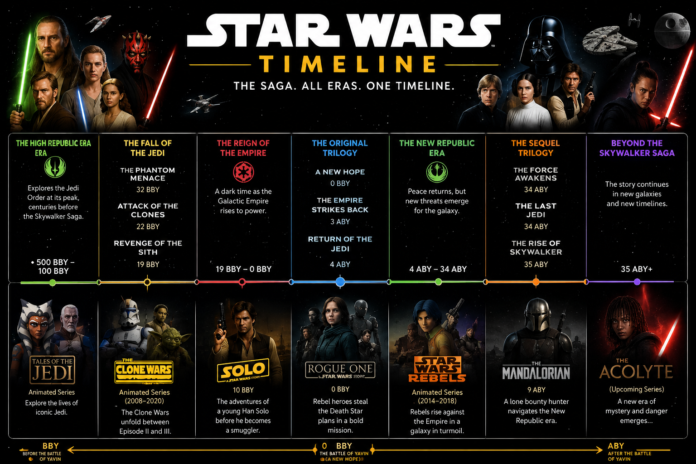
If you want the simplest chronological overview, the major eras can be understood like this:
- Dawn of the Jedi – thousands of years before the Skywalker saga
- The High Republic – roughly 500 to 100 BBY
- The Fall of the Jedi – around 32 to 19 BBY
- The Reign of the Empire – around 19 BBY onward
- The Age of Rebellion – around 5 BBY to 4 ABY
- The New Republic – after the fall of the Empire
- The Rise of the First Order – before and during the sequel trilogy
- The New Jedi Order era – the period following The Rise of Skywalker
These labels make the overall Star Wars Timeline Wars universe easier to understand because they group stories according to major historical changes rather than simply listing titles.
The High Republic Era
The High Republic is one of the earliest major periods explored extensively in modern Star Wars Timeline Wars storytelling. It takes place centuries before the events of The Phantom Menace. During this period, the Jedi Order is powerful, respected, and deeply involved in protecting the Republic.
Stories from the High Republic explore a galaxy that looks very different from the one seen during the Skywalker saga. The Jedi are not yet facing the same political and military problems that eventually lead to the Clone Wars. Instead, they are dealing with threats such as the Nihil, a dangerous group that challenges the Republic’s control of hyperspace.
The High Republic is particularly interesting because it shows the Jedi before their organization becomes increasingly connected to the political institutions of the Republic. It gives fans a chance to see the Jedi at the height of their influence and helps explain the historical background of the galaxy before the prequel movies.
Star Wars: The Acolyte
The Acolyte is set toward the end of the High Republic era, long before the Skywalker saga. The series explores a period when the Jedi are still a major force in the galaxy, but darker events are beginning to emerge.
The story focuses on mysterious crimes and threats connected to the Jedi and the Force. Its placement in the Star Wars Timeline Wars timeline is important because it shows the galaxy during a period that had previously received much less attention on screen.
For viewers interested in the history of the Jedi, this era provides useful context. It also helps demonstrate that the problems eventually seen in the prequel trilogy did not appear overnight.
Star Wars: Episode I – The Phantom Menace
The main Skywalker-era timeline begins with Episode I – The Phantom Menace, which takes place around 32 BBY. The story introduces young Anakin Skywalker, Obi-Wan Kenobi, Qui-Gon Jinn, Padmé Amidala, and Darth Maul.
At this point, the Galactic Republic has existed for a very long time, and the Jedi Order serves as a peacekeeping organization. However, political tensions are growing. The Trade Federation’s blockade of Naboo becomes the event that brings several major characters together.
The movie is especially important because Anakin’s discovery eventually changes the entire galaxy. His journey from a gifted child to one of the most important figures in Star Wars Timeline Wars begins here.
Star Wars: Episode II – Attack of the Clones
Ten years after The Phantom Menace, Attack of the Clones takes place around 22 BBY. Anakin Skywalker is now a Jedi Padawan under Obi-Wan Kenobi, while Padmé Amidala has become a senator.
The galaxy is moving toward a major conflict. Separatist movements are challenging the Republic, and Obi-Wan’s investigation eventually leads him to discover a secret clone army. The events on Geonosis mark the beginning of the Clone Wars.
This movie is a major turning point in the Star Wars Timeline Wars timeline. The Republic moves from political tension into full-scale war, and Anakin begins a path that will eventually have enormous consequences for the Jedi Order.
The Clone Wars
Star Wars: The Clone Wars takes place between Attack of the Clones and Revenge of the Sith. The animated series follows Anakin, Obi-Wan, Ahsoka Tano, Captain Rex, and many other characters during the Clone Wars.
Ahsoka is one of the most important additions to the Star Wars Timeline Wars story. She begins as Anakin’s Padawan and gradually becomes a skilled and independent Force user. Her relationship with Anakin also gives viewers a different perspective on his personality before his fall.
The series contains many separate story arcs, so it is much larger than a single movie. However, its position in the timeline is clear: it occurs during the Clone Wars and leads directly into the final stages of the Republic’s collapse.
Star Wars: Episode III – Revenge of the Sith
Revenge of the Sith takes place around 19 BBY and represents one of the darkest turning points in the Star Wars Timeline Wars timeline. The Clone Wars are coming to an end, but Chancellor Palpatine’s secret identity as Darth Sidious is finally revealed.
Anakin Skywalker becomes increasingly afraid of losing Padmé. Palpatine uses that fear to manipulate him and eventually convinces Anakin that the dark side can help him prevent the future he fears.
The Jedi Order is destroyed as Palpatine transforms the Galactic Republic into the Galactic Empire. Anakin becomes Darth Vader, Obi-Wan defeats him, and the Skywalker twins are separated. These events directly establish the world seen in the original trilogy.
The Empire Era
After the events of Revenge of the Sith, the Galactic Empire controls most of the galaxy. The Jedi have been hunted down, and Darth Vader becomes one of the Emperor’s most powerful agents.
Several Star Wars Timeline Wars stories take place during this period. The Bad Batch follows clone troopers dealing with the transformation from the Republic military into the Imperial system. Obi-Wan Kenobi explores Obi-Wan’s life years after the Jedi purge.
Solo: A Star Wars Story also belongs to this general period. It follows a younger Han Solo and shows how he meets characters such as Chewbacca and Lando Calrissian. These stories help fill in the years between the prequel and original trilogies.
Star Wars Rebels
Star Wars Rebels takes place several years before A New Hope. The series follows a small group of rebels who gradually become part of the larger fight against the Empire.
The story introduces or develops characters including Ezra Bridger, Kanan Jarrus, Hera Syndulla, Sabine Wren, Zeb, and Chopper. It also features important appearances from Darth Vader, Ahsoka Tano, and other familiar characters.
The series is particularly valuable for understanding the early Rebel Alliance. It shows that the rebellion was not created by one person or one organization. Instead, different groups slowly came together to challenge Imperial rule.
Rogue One: A Star Wars Story
Rogue One takes place immediately before A New Hope. The movie follows a group of rebels who attempt to obtain the plans for the Death Star Wars Timeline.
Its position in the Star Wars Timeline Wars timeline is especially easy to remember because its ending connects directly with the opening of A New Hope. The movie explains how the Rebel Alliance obtained the information that eventually allowed Luke Skywalker to discover the Death Star’s weakness.
Unlike many Star Wars Timeline Wars stories, Rogue One focuses heavily on ordinary people participating in a massive galactic conflict. That makes it an important bridge between the prequel-era stories and the original trilogy.
Star Wars: Episode IV – A New Hope
A New Hope takes place around 0 BBY/0 ABY, depending on how the event is referenced. It introduces Luke Skywalker, Leia Organa, Han Solo, Chewbacca, and Darth Vader in the classic conflict between the Rebel Alliance and the Galactic Empire.
Luke begins as a young farm boy living on Tatooine. His life changes after he encounters Obi-Wan Kenobi and becomes involved with the rebellion.
The movie establishes many of the ideas that define Star Wars Timeline Wars: the Force, the Jedi, the Sith, the Empire, the Rebel Alliance, and the Skywalker family’s importance. It is also the point commonly used as the central reference for the BBY and ABY dating system.
The Original Trilogy Continues
After A New Hope comes The Empire Strikes Back. The story takes place several years after the destruction of the first Death Star Wars Timeline. Luke continues his Jedi training while the Empire searches for the Rebel Alliance.
Return of the Jedi follows and brings the original trilogy to its major conclusion. Luke confronts Darth Vader and Emperor Palpatine, while the Rebel Alliance launches an attack against the second Death Star.
These three movies form the core of the original Star Wars Timeline Wars story. They also establish the redemption of Darth Vader and the defeat of the Galactic Empire.
The Mandalorian and the New Republic Era
After the original trilogy, the galaxy enters a new period known as the New Republic era. The Empire has fallen, but peace does not immediately return.
The Mandalorian takes place several years after Return of the Jedi. It follows Din Djarin, a Mandalorian bounty hunter, and Grogu. The series explores the political and social conditions of the galaxy after the Empire’s defeat.
Other stories, including The Book of Boba Fett and Ahsoka, are connected to this era. Together, they expand the story of the New Republic and introduce conflicts that eventually become relevant to the sequel trilogy.
Star Wars: Episode VII – The Force Awakens
The Force Awakens takes place decades after Return of the Jedi. The original heroes have become legends, and a new generation takes center stage.
Rey, Finn, Poe Dameron, and Kylo Ren become central characters. The First Order has emerged as a powerful threat, while the Resistance fights to stop its expansion.
The movie connects the new characters to the legacy of Luke, Leia, Han, and Darth Vader. It effectively begins the sequel trilogy while continuing the larger Skywalker story.
The Last Jedi and The Rise of Skywalker
The Last Jedi follows Rey’s search for Luke Skywalker and explores the complicated history of the Jedi. At the same time, the Resistance struggles to survive against the First Order.
The Rise of Skywalker concludes the Skywalker saga. Rey, Kylo Ren, and the Resistance face the return of Emperor Palpatine and the threat of a massive final conflict.
Together, the sequel trilogy brings the main nine-episode Skywalker saga to an end. It also leaves the Star Wars Timeline Wars universe open for future stories that can explore completely different periods and characters.
Complete Star Wars Movie Timeline
For someone who wants to watch the main Star Wars Timeline Wars movies chronologically, this is the simplest order:
- Episode I – The Phantom Menace
- Episode II – Attack of the Clones
- Episode III – Revenge of the Sith
- Solo: A Star Wars Story
- Rogue One: A Star Wars Story
- Episode IV – A New Hope
- Episode V – The Empire Strikes Back
- Episode VI – Return of the Jedi
- Episode VII – The Force Awakens
- Episode VIII – The Last Jedi
- Episode IX – The Rise of Skywalker
This order works well for viewers who want to experience the major events chronologically. However, first-time viewers may also enjoy release order because the original trilogy was designed to introduce the Star Wars Timeline Wars universe before the prequel and sequel stories expanded it.
Should You Watch Star Wars in Chronological or Release Order?
There is no single correct answer. Chronological order makes the story easier to follow from a historical perspective. You see Anakin’s childhood, the Clone Wars, the rise of Darth Vader, the fall of the Empire, and the eventual rise of a new generation.
Release order, however, preserves the way audiences originally experienced Star Wars Timeline Wars. You meet Luke, Leia, Han, and Darth Vader before learning the full history of the Jedi and Anakin Skywalker.
For a first-time viewer, release order is often a fun choice because it preserves the original storytelling structure. For someone who has already seen the movies and wants to understand the broader history, the Star Wars chronological timeline can be much more satisfying.
Final Thoughts on the Star Wars Timeline
The Star Wars timeline is much bigger than the nine main episodes. From the High Republic and the rise of the Sith to the Clone Wars, Galactic Empire, Rebel Alliance, New Republic, and First Order, the galaxy contains thousands of years of history.
The easiest way to understand it is to start with the major eras instead of trying to memorize every single story. The prequel trilogy explains the fall of the Republic, the original trilogy follows the rebellion against the Empire, and the sequel trilogy explores the next generation after the Empire’s defeat.
Once you understand those major connections, the rest of the Star Wars Timeline Wars universe becomes much easier to explore. Whether you prefer movies, animated series, or live-action shows, knowing where each story fits makes the entire galaxy feel more connected—and a lot more fun to revisit.
You May Also Read: Flipkart Tracking: How to Track Your Order Easily in 2026