
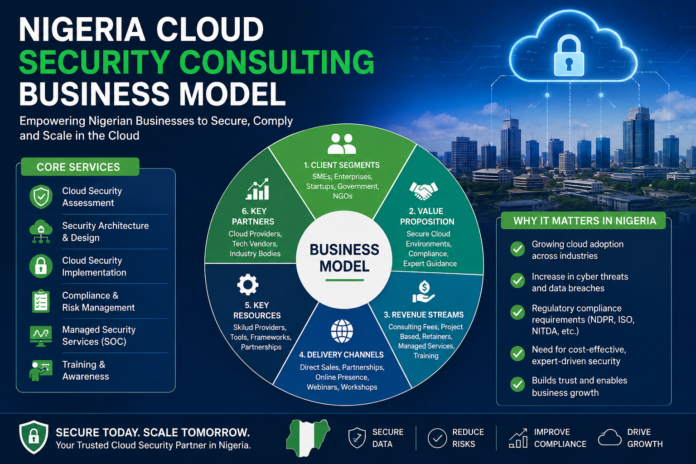

Nigeria Cloud Security Consulting Business Model Cloud computing is changing the way Nigerian businesses store data, run applications, communicate with customers, and manage everyday operations. From financial services and e-commerce companies to healthcare providers, schools, startups, and professional firms, more organisations are depending on cloud platforms to stay flexible and competitive. But moving business operations to the cloud also creates new security responsibilities. This is where the Nigeria cloud security consulting business model becomes increasingly important.
A cloud security consulting business helps organisations understand their cloud risks, protect sensitive information, improve access controls, secure applications, and meet relevant regulatory requirements. Instead of selling one security product, consultants can provide a combination of assessment, strategy, implementation, training, monitoring, and ongoing advisory services.
Nigeria’s cybersecurity environment is also becoming more demanding. Deloitte’s 2026 Nigeria Cybersecurity Outlook highlights the growing use of cloud platforms, APIs, and shared digital services while warning that these technologies can expand an organisation’s attack surface when security is not built into systems from the beginning. This creates an opportunity for specialised consulting firms that can explain complicated security issues in practical business language.
What Is a Cloud Security Consulting Business Model in Nigeria?
A cloud security consulting business model is a service-based approach in which a company helps Nigerian organisations identify, manage, and reduce security risks associated with cloud computing. Rather than building a single cloud platform, the consultant works with existing environments such as Microsoft Azure, Amazon Web Services, Google Cloud, Microsoft 365, or hybrid infrastructure.
The business can start with a security assessment. Consultants review identity and access management, cloud configurations, data protection, network architecture, backup arrangements, logging, monitoring, and security policies. The client then receives a practical report explaining the most important weaknesses and what should be fixed first.
The model can then move beyond one-time projects into recurring services. For example, a consulting company might complete an initial cloud security assessment and later provide monthly security reviews, compliance support, employee awareness training, vulnerability management, or managed monitoring. This combination of project revenue and recurring revenue can make the business more sustainable.
Why Cloud Security Consulting Is Becoming Important in Nigeria
One major reason for the opportunity is the rapid digitalisation of Nigeria Cloud Security Consulting Business Model n businesses. Companies increasingly depend on online banking, cloud software, digital payments, remote collaboration, customer databases, APIs, and web applications. These systems can improve efficiency, but they also make security a business issue rather than simply an IT issue.
Cybersecurity concerns are particularly important for organisations handling financial, personal, medical, customer, or commercially sensitive information. A security incident can cause downtime, financial losses, reputational damage, and regulatory problems. Businesses therefore need more than antivirus software; they need a structured approach to protecting their entire cloud environment.
The Nigerian cybersecurity market is also being shaped by cloud-delivered security services, identity management, application security, and managed security offerings. Market research identifies consulting, managed services, and training as important service categories within Nigeria Cloud Security Consulting Business Model’s cybersecurity landscape. For a new consulting firm, this means there are multiple ways to create a service portfolio rather than depending on one product.
Core Services a Nigerian Cloud Security Consultant Can Offer
The first service should usually be a cloud security assessment. This gives businesses a clear picture of their current security position. The consultant can review user permissions, authentication, storage settings, network controls, encryption, logging, backup procedures, and configuration risks. The goal is not simply to produce a long technical report but to explain which risks deserve immediate attention.
A second important service is secure cloud architecture and migration consulting. Some Nigeria Cloud Security Consulting Business Model n businesses move workloads to the cloud without fully redesigning their security controls. A consultant can help create secure architectures, define appropriate access policies, separate environments, protect sensitive workloads, and establish security requirements before migration. This is especially useful for organisations moving from traditional on-premises infrastructure to hybrid or cloud-based systems.
A third service is compliance and data protection consulting. The Nigeria Data Protection Act 2023 created a legal framework for personal-data protection and established the Nigeria Cloud Security Consulting Business Model Data Protection Commission. Consulting firms can help clients understand their responsibilities, improve data-handling practices, prepare documentation, and strengthen technical controls that support privacy requirements.
The Role of the Nigeria Data Protection Act
Data protection should be a major part of the business model because many cloud systems contain personal information. The Nigeria Cloud Security Consulting Business Model Data Protection Commission states that the Nigeria Data Protection Act is designed to regulate the processing of personal data, promote secure data-processing practices, protect data-subject rights, and strengthen Nigeria’s digital economy.
For consultants, this creates opportunities beyond traditional technical security. A client may need help understanding where personal data is stored, who can access it, how it moves between systems, how long it is retained, and what procedures should exist when a security incident occurs. Cloud security consulting can connect these privacy questions with practical technical controls.
There is also a specific professional opportunity around Data Protection Compliance Organisations, or DPCOs. The NDPC explains that licensed DPCOs can provide services including data-protection compliance advisory, training, audits, breach support, privacy assessments, and related services. A consulting business interested in offering regulated data-protection services should therefore understand the applicable NDPC requirements rather than presenting ordinary cybersecurity consulting as automatically equivalent to DPCO services.
Choosing the Right Target Market
A new cloud security consulting company should avoid trying to serve every type of Nigeria Cloud Security Consulting Business Model n business from day one. A focused target market makes marketing easier and allows the company to develop specialised expertise. Financial services, fintech, healthcare, telecommunications, professional services, e-commerce, education, logistics, and technology companies can all have meaningful cloud-security needs.
Small and medium-sized businesses can also represent an attractive market. Many smaller organisations cannot afford a large internal cybersecurity department, yet they still use cloud email, online accounting, customer databases, websites, payment systems, and collaboration tools. A consultant can offer simpler packages designed around their actual needs instead of selling expensive enterprise solutions.
Larger organisations usually have more complex requirements and may expect formal assessments, architecture reviews, compliance support, penetration testing through qualified specialists, incident-response planning, and ongoing security monitoring. A consulting firm can therefore create different service tiers for startups, SMEs, and enterprise customers.
How the Consulting Business Can Make Money
A strong Nigeria cloud security consulting business model should not depend entirely on hourly consulting. One-time projects can generate good revenue, but recurring services provide greater predictability. A practical model can combine fixed-price assessments, implementation projects, training, monthly retainers, and managed security services.
For example, the company could sell an initial cloud security assessment as a fixed-scope engagement. After completing the assessment, it could offer an implementation package for addressing the highest-priority findings. The customer could then move to a monthly security advisory plan covering regular reviews, reporting, policy updates, and consultation.
Subscription-based services can become especially valuable as the customer base grows. Instead of repeatedly finding new clients for every project, the firm can maintain relationships with existing customers. Nigeria Cloud Security Consulting Business Model IT service providers already use combinations of project-based cybersecurity work, consulting, and ongoing support, showing how flexible pricing models can fit different client needs.
Suggested Pricing Structure
Pricing should be based on scope, complexity, risk, number of systems, number of users, compliance requirements, and the level of ongoing support. A small cloud-security review should naturally cost less than a large enterprise architecture project involving multiple environments and business units.
A simple structure could include three levels. The first might be an entry-level security health check for smaller organisations. The second could be a comprehensive cloud security assessment with a detailed remediation roadmap. The third could be an ongoing security partnership that includes periodic assessments, advisory support, training, and monitoring.
The exact prices should not be copied from another company because Nigerian businesses have very different requirements. Publicly advertised Nigeria Cloud Security Consulting Business Model cybersecurity services show that providers use both affordable monthly monitoring packages and significantly larger project-based engagements depending on scope. The better approach is to create transparent packages while offering customised enterprise quotations for complex environments.
Building a Strong Cloud Security Consulting Team
A consulting business does not necessarily need a huge team at launch. A small group of skilled professionals can cover the core functions if responsibilities are clearly defined. The founding team might include a cloud security architect, cybersecurity consultant, compliance specialist, and business-development professional.
Technical certifications can also help establish credibility, although certifications alone do not guarantee good consulting. Clients want people who can understand their business, explain risks clearly, and turn recommendations into practical improvements. Experience with cloud architecture, identity security, security operations, governance, and data protection can therefore be valuable.
As the business grows, specialists can be added for areas such as penetration testing, incident response, security monitoring, DevSecOps, application security, and privacy. A partnership model can also work for specialist services where hiring a full-time expert would not make financial sense.
Technology and Tools Needed
A cloud security consultancy needs reliable tools for assessment, documentation, reporting, monitoring, and collaboration. The exact technology stack will depend on which cloud platforms the company supports. Consultants should understand the native security capabilities of major cloud providers as well as independent security and compliance tools.
Identity and access management should be a major focus. Strong authentication, least-privilege access, privileged-account protection, secure configuration, logging, and appropriate monitoring are fundamental parts of modern cloud security. These controls should be adapted to the client’s size and risk rather than implemented simply because they are fashionable.
Documentation is equally important. A professional consulting company should produce clear assessment reports, risk registers, remediation roadmaps, policies, architecture diagrams, and executive summaries. A business owner should be able to understand the important risks without needing to read hundreds of pages of technical terminology.
Marketing Strategy for a Nigerian Cloud Security Consultancy
Marketing should focus on education rather than fear. Instead of telling potential customers that they will definitely be hacked, a consultancy can publish useful content explaining common cloud-security mistakes, identity risks, data-protection responsibilities, secure Microsoft 365 practices, cloud migration security, and cybersecurity planning.
LinkedIn can be useful for reaching technology managers, founders, executives, compliance professionals, and IT decision-makers. Search-engine optimisation can also generate long-term traffic through articles targeting phrases such as “cloud security consulting in Nigeria,” “cloud security services Nigeria,” “Nigeria Cloud Security Consulting Business Model cloud cybersecurity,” “cloud compliance consulting Nigeria,” and related questions.
Partnerships are another practical growth channel. A consultancy could work with software providers, cloud migration companies, IT support firms, accounting firms, legal professionals, technology communities, and business associations. The goal is to become the security specialist that complementary service providers can confidently recommend to their clients.
Creating Trust and Credibility
Trust is one of the most important assets in cybersecurity consulting. Clients are giving the consultant access to sensitive systems and information, so professionalism matters as much as technical knowledge. A new company should have clear contracts, confidentiality procedures, secure internal systems, documented processes, and strong access controls for its own employees.
Case studies can be extremely powerful once the company has completed successful projects. Instead of simply claiming that the business provides “enterprise-grade security,” a case study can explain the client’s initial challenge, the approach taken, the improvements made, and measurable outcomes where disclosure is permitted.
Professional credentials and regulatory knowledge can also strengthen credibility. For services involving Nigeria Cloud Security Consulting Business Model data-protection compliance, consultants should understand the NDPC framework and clearly distinguish general advisory work from services that require specific licensing or professional status. The NDPC provides formal requirements and guidance for DPCO registration.
Common Challenges in the Nigerian Market
One challenge is price sensitivity. Some businesses still view cybersecurity as an expense rather than an investment. Consultants need to connect security recommendations to business outcomes such as reducing downtime, protecting customer trust, supporting compliance, and preventing avoidable operational problems.
Another challenge is the shortage of experienced cybersecurity professionals. A small consulting firm may struggle to handle several complex clients at once. Building repeatable processes, investing in staff development, and using automation responsibly can help the company scale without sacrificing service quality.
Infrastructure and operational realities can also influence cloud decisions. Nigeria Cloud Security Consulting Business Model organisations may use combinations of cloud services, local infrastructure, hybrid environments, and third-party providers. A good consultant should therefore avoid assuming that every customer needs a completely cloud-native architecture. The right solution depends on business requirements, security risks, regulatory considerations, budget, and operational capability.
A Practical Growth Strategy
The best way to build the business is to start narrow and expand gradually. A new consultancy could begin with cloud security assessments, Microsoft 365 security reviews, cloud configuration reviews, data-protection advisory, and employee security awareness training. These services can be delivered with a relatively focused team.
Once the company has established a customer base, it can introduce recurring advisory subscriptions, vulnerability management, security monitoring partnerships, incident-response retainers, and more advanced cloud architecture services. This creates several revenue streams while increasing the value of each customer relationship.
Over time, the company can develop industry-specific packages. For example, a fintech security package could focus on identity, API security, cloud infrastructure, monitoring, and regulatory requirements, while a healthcare package could place greater emphasis on sensitive personal information, access controls, data governance, and business continuity. Specialisation can make the consultancy easier to remember and easier to recommend.
Future of Cloud Security Consulting in Nigeria
The future looks increasingly focused on identity, automation, secure application development, zero-trust principles, cloud-native monitoring, and continuous risk management. Deloitte’s 2026 outlook specifically points to growing attention around zero trust, identity-focused security, AI-related risks, APIs, and cloud platforms.
This means cloud security consulting will gradually move away from the old model of performing an occasional security audit and handing over a report. Businesses increasingly need continuous visibility and practical security improvements. Consultants who can combine strategy, implementation, education, compliance, and ongoing support are likely to offer more value than firms that only provide technical assessments.
Nigeria’s policy environment is also evolving. NITDA’s current regulations and resources include national cloud-computing guidance and other digital infrastructure frameworks, showing that cloud adoption is becoming an increasingly important part of the country’s digital policy landscape. Consultants should therefore monitor regulatory developments and update their services accordingly.
Conclusion
The Nigeria cloud security consulting business model offers a practical opportunity for technology professionals and consulting companies that understand both cybersecurity and theNigeria Cloud Security Consulting Business Model business environment. The strongest model is not simply selling security tools. It is helping organisations understand their risks, build safer cloud environments, meet relevant obligations, and maintain security as their businesses grow.
A successful consultancy can combine fixed-price assessments with implementation projects, training, compliance advisory, and recurring security subscriptions. Starting with a focused market, building genuine technical expertise, developing trustworthy processes, and creating useful educational content can help a new firm compete without trying to become everything to everyone.
Most importantly, cloud security should be presented as a business enabler rather than a technical burden. Nigeria Cloud Security Consulting Business Model n organisations want the benefits of cloud technology—speed, flexibility, collaboration, and scalability—without exposing their customers or operations to unnecessary risk. A well-designed consulting business can sit directly between those two needs, helping companies adopt cloud technology with greater confidence while building a sustainable and scalable professional-services business.
You May Also Read ; Shaun So: Biography, Career, Family, and Life Story