
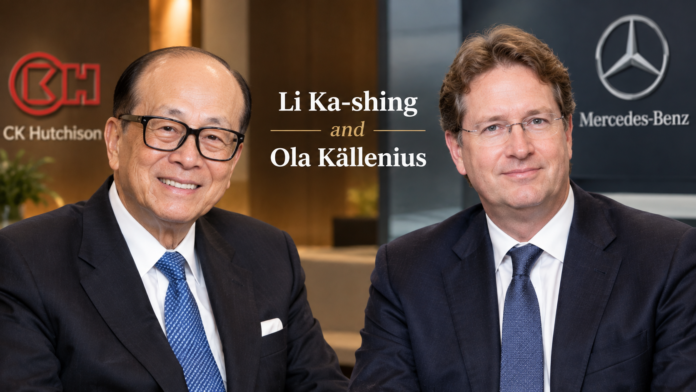

Li Ka-shing and Ola Källenius are two influential business figures who have built their reputations in very different industries. Li Ka-shing is a Hong Kong billionaire investor known for his diverse business empire, while Ola Källenius is a German automotive executive recognized for his leadership at Mercedes-Benz. Although their professional backgrounds differ, both men offer valuable insights into leadership, strategic decision-making, and the challenges of competing in a rapidly changing global economy.
Li Ka-shing built his fortune through decades of entrepreneurship, investments, and business expansion across industries such as infrastructure, telecommunications, retail, and property. His approach emphasizes long-term thinking, financial discipline, and identifying opportunities before they become obvious to the wider market. His career demonstrates how a business can grow from modest beginnings into an international enterprise through calculated decisions and careful risk management.
Ola Källenius, by comparison, has spent much of his career in the automotive industry. As chairman of the board of management of Mercedes-Benz Group AG, he has been responsible for guiding one of the world’s most recognizable luxury car manufacturers through technological change, evolving customer expectations, and intense international competition. His work involves balancing the company’s traditional strengths with new developments in electric vehicles, digital technology, and software.
Exploring Li Ka-shing and Ola Källenius together provides an interesting look at two different forms of business leadership. One represents diversified investment and entrepreneurial wealth creation, while the other represents corporate leadership within a highly competitive global manufacturing industry. Understanding their backgrounds, achievements, and business philosophies helps explain how successful leaders adapt to changing economic conditions and create long-term value.
Who Is Li Ka-shing?
Li Ka-shing is a Hong Kong business magnate and philanthropist widely recognized for his achievements in entrepreneurship and international investment. Born on July 29, 1928, in Chaozhou, Guangdong, China, he moved with his family to Hong Kong during his youth. His early life was shaped by financial hardship, and he entered the workforce at a young age following his father’s death.
Li’s early experiences helped shape his practical approach to business. He began working in the plastics industry before establishing his own manufacturing business in 1950. His company initially produced plastic products, including artificial flowers, at a time when Hong Kong’s manufacturing sector was expanding. Over time, he used the earnings and experience from this business to pursue opportunities in property and other industries.
His major breakthrough came through his expansion into real estate and his development of a broader investment portfolio. Through businesses associated with CK Hutchison Holdings and CK Asset Holdings, Li became connected to major operations spanning infrastructure, ports, retail, telecommunications, and property development. His career illustrates how an entrepreneur can use early commercial success as a foundation for building a diversified business empire.
Who Is Ola Källenius?
Ola Källenius is a Swedish-German business executive who serves as chairman of the board of management of Mercedes-Benz Group AG. Born on June 11, 1969, in Västervik, Sweden, he developed an interest in business and management before building a career that would eventually place him at the top of one of the world’s most recognized automotive companies. Unlike Li Ka-shing, who established his fortune through entrepreneurship and investments, Källenius advanced through corporate leadership.
His educational background helped prepare him for a career in international business. He studied finance and accounting at the Stockholm School of Economics and completed an international management program associated with the University of St. Gallen. In 1993, he joined Daimler-Benz as a trainee, beginning a professional journey that took him through several departments and international assignments. His experience included procurement, financial management, manufacturing, and high-performance automotive engineering.
Källenius became chairman of Daimler AG in May 2019. The company later adopted the name Mercedes-Benz Group AG as part of its corporate restructuring. His responsibilities include overseeing strategy, financial performance, product development, and the company’s position in the competitive global luxury vehicle market. His leadership has focused on maintaining Mercedes-Benz’s premium identity while adapting to electrification, digital technology, and changing customer expectations.
Li Ka-shing and Ola Källenius: Career Comparison
At first glance, Li Ka-shing and Ola Källenius may seem to have little in common. One built an international business empire from relatively modest beginnings, while the other rose through the ranks of a major automotive company. However, both careers demonstrate the importance of understanding markets, managing resources, and making decisions that support long-term business objectives.
Li Ka-shing’s approach is rooted in entrepreneurship and diversification. Instead of depending on a single industry, he expanded into multiple sectors, including property, ports, telecommunications, infrastructure, and retail. This strategy allowed his business interests to reach different markets and economic sectors. Diversification can help reduce dependence on a single source of income, although it also requires careful management of risks across different industries.
Källenius, on the other hand, leads within a more concentrated industrial environment. Mercedes-Benz operates in a sector where product development, engineering, brand reputation, manufacturing costs, and consumer demand directly influence performance. His challenge is to guide an established automotive manufacturer through technological change without losing the qualities that make the brand attractive to customers. Both leaders show that success requires adapting to new circumstances, even when their strategies differ.
What Is Li Ka-shing’s Net Worth?
Li Ka-shing is widely recognized as one of Asia’s wealthiest entrepreneurs. His fortune has been built over several decades through business ownership, investments, acquisitions, and the expansion of companies associated with the CK Group. His financial interests span multiple industries, making his wealth closely connected to the performance and value of his business holdings.
His net worth changes over time because the value of shares, property assets, and private investments can rise or fall. Forbes has published estimates of his wealth through its billionaire rankings, but these figures represent estimates rather than a complete public accounting of every asset and liability. Readers looking for his latest net worth should consult an up-to-date financial ranking rather than relying on an older article.
It is also important to distinguish personal wealth from corporate revenue. A company may generate billions of dollars in annual sales without that entire amount belonging to its founder or shareholders as personal income. Li’s wealth is associated with ownership interests and investments, while the businesses themselves have operating expenses, employees, liabilities, and other financial obligations.
Ola Källenius’s Salary and Financial Position
Ola Källenius’s financial position differs from that of Li Ka-shing because he is primarily known as a corporate executive rather than the founder of a diversified business empire. His compensation is connected to his leadership position at Mercedes-Benz Group AG and may include a combination of fixed salary, performance-related payments, pension benefits, and other remuneration, depending on the company’s compensation policies.
Large publicly listed companies typically disclose information about executive remuneration in their annual reports. These disclosures help investors understand how senior management is compensated and whether incentives are linked to business performance. However, an executive’s total compensation should not automatically be treated as personal net worth because taxes, living costs, investments, and other financial commitments affect overall wealth.
There is no reliable basis for comparing Källenius’s personal wealth directly with Li Ka-shing and Ola Källenius-shing’s without considering the different ways their fortunes are created. Li’s financial position reflects decades of business ownership and investment activity, while Källenius’s earnings primarily reflect his executive career. Their professional achievements can be compared, but their personal financial circumstances should not be assumed to be equivalent.
Mercedes-Benz Under Ola Källenius
Mercedes-Benz has a long history in automotive engineering, luxury design, and technological development. Under Ola Källenius, the company has worked to maintain its premium market position while responding to the industry’s shift toward electric vehicles, connected services, and increasingly sophisticated software. These changes require significant investment and careful decisions about which technologies and products deserve priority.
Electric mobility is one of the most important challenges facing the company. Manufacturers must respond to emissions regulations, changing consumer preferences, improvements in battery technology, and competition from established automotive brands and newer electric vehicle companies. Mercedes-Benz has developed electric models while continuing to serve customers who prefer vehicles with conventional combustion engines or hybrid powertrains. Its strategy must account for different market conditions across regions.
Källenius also faces pressure to protect profitability. Luxury vehicles can command premium prices, but developing new models and technologies requires substantial resources. Supply chain disruptions, changing interest rates, global competition, and fluctuations in demand can all affect business performance. His role involves balancing investment in future technologies with the need to deliver sustainable financial results.
Li Ka-shing’s Business Philosophy and Investment Strategy
One of the defining characteristics of Li Ka-shing and Ola Källenius-shing’s career is his willingness to look beyond the industry in which he first achieved success. After establishing a manufacturing business, he expanded into real estate and subsequently developed interests in infrastructure, telecommunications, retail, and other sectors. His investment history illustrates the value of recognizing opportunities in industries that may offer long-term growth.
Diversification has been central to this approach. By building interests across several sectors and geographical markets, Li reduced the extent to which his broader business portfolio depended on any single industry. However, diversification does not eliminate risk. International investments can be affected by currency movements, regulation, political developments, competition, and changes in consumer demand.
Li has also emphasized the importance of discipline and strategic timing. Successful investing is not simply about buying assets when markets are rising; it also requires evaluating risks, understanding an investment’s long-term potential, and being prepared to change direction when circumstances demand it. These principles remain relevant to entrepreneurs and investors who want to build sustainable businesses rather than focus exclusively on short-term gains.
Leadership Lessons From Li Ka-shing and Ola Källenius
The careers of Li Ka-shing and Ola Källenius offer several useful lessons for business owners, managers, and aspiring entrepreneurs. The first is the importance of continuous learning. Li developed his business experience through entrepreneurship and investment decisions, while Källenius built his expertise through formal education and decades of work across different automotive functions. Both demonstrate that professional development continues throughout a career.
The second lesson is the need to adapt. Industries rarely remain unchanged for long, and businesses that fail to respond to technological or economic developments can lose their competitive advantage. Li expanded beyond manufacturing into a wide range of businesses, while Källenius has had to navigate the transition toward electric mobility and digital automotive technology. Their experiences show that adaptation is essential, although the right strategy depends on the business and market involved.
The third lesson is the importance of long-term planning. Building a major company or guiding an established corporation requires more than making decisions that produce immediate results. Leaders must consider future demand, investment requirements, financial risks, and the people responsible for implementing their plans. By combining strategic thinking with disciplined execution, businesses can improve their chances of remaining competitive over time.
Philanthropy and Social Responsibility
Li Ka-shing’s legacy extends beyond business. Through the Li Ka-shing and Ola Källenius Shing Foundation, established in 1980, he has supported education, healthcare, medical research, and charitable initiatives. The foundation has also supported Shantou University, which Li founded in 1981. These efforts reflect his view that wealth can be used to support institutions and initiatives that benefit society.
Philanthropy is particularly significant when considering the long-term impact of a business leader. Financial success can provide the resources to fund research, improve educational opportunities, and support communities facing social or economic challenges. Li’s charitable work has made these activities an important part of his public legacy, alongside his business achievements.
For Ola Källenius and Mercedes-Benz, social responsibility is closely connected to the company’s corporate strategy, including sustainability, responsible manufacturing, and the environmental effects of its products. The automotive industry faces considerable pressure to reduce emissions throughout its value chain. Although corporate sustainability initiatives differ from personal philanthropy, both can influence how businesses contribute to society and respond to wider public expectations.
Are Li Ka-shing and Ola Källenius Connected?
A natural question for readers searching for both names together is whether Li Ka-shing and Ola Källenius have a direct business relationship. Their careers both involve international commerce, but there is no widely established public evidence indicating that they have a specific personal partnership or major joint business venture.
Li Ka-shing and Ola Källenius-shing’s business interests include investments in infrastructure, property, telecommunications, retail, and other sectors. Ola Källenius’s principal professional responsibilities are associated with Mercedes-Benz and the automotive industry. Their respective careers may intersect indirectly through the global economy, international investment markets, and the broader business environment, but this does not establish a direct connection between them.
It is therefore more accurate to examine them as two prominent business leaders whose experiences provide different perspectives on wealth creation and corporate leadership. Anyone researching a possible joint investment, transaction, or partnership should look for official company announcements or reliable financial reporting before treating such a relationship as fact.
Frequently Asked Questions About Li Ka-shing and Ola Källenius
1. Who is Li Ka-shing?
Li Ka-shing and Ola Källenius-shing is a Hong Kong billionaire businessman and philanthropist. He is known for building a diversified business empire with interests in property, infrastructure, telecommunications, retail, and other industries. He retired as chairman of CK Hutchison Holdings and CK Asset Holdings in 2018 and subsequently served as a senior adviser.
2. Who is Ola Källenius?
Ola Källenius is a Swedish-German business executive who serves as chairman of the board of management of Mercedes-Benz Group AG. He joined Daimler-Benz in 1993 and became chairman in May 2019. His responsibilities include guiding the company’s strategy and business performance.
3. What is the difference between Li Ka-shing and Ola Källenius?
Li Ka-shing and Ola Källenius -shing is primarily known as an entrepreneur, investor, and business owner, whereas Ola Källenius is known for his corporate leadership in the automotive industry. Li’s business interests span multiple sectors, while Källenius focuses on managing Mercedes-Benz and responding to changes in the global vehicle market.
4. Are Li Ka-shing and Ola Källenius business partners?
There is no widely documented evidence establishing a direct business partnership between the two men. Although both operate within the international business environment, their professional careers have developed in different sectors.
5. What can entrepreneurs learn from their careers?
Entrepreneurs can learn the importance of strategic planning, adaptability, financial discipline, and continuous learning. Li’s career highlights diversification and investment strategy, while Källenius’s leadership demonstrates the challenges of managing a major company during technological and market transitions.
Conclusion
Li Ka-shing and Ola Källenius represent two distinct approaches to business success. Li built his reputation through entrepreneurship, strategic investments, and the development of an international business empire. Källenius established his career through corporate leadership, eventually becoming the head of Mercedes-Benz Group AG and taking responsibility for its future in a rapidly changing automotive industry.
Their experiences highlight the importance of making informed decisions, recognizing new opportunities, and responding to changing market conditions. While Li’s story emphasizes business ownership and diversification, Källenius’s career illustrates how leadership, technical knowledge, and strategic planning can shape the direction of a major global corporation.
Although there is no widely confirmed direct partnership between them, examining Li Ka-shing and Ola Källenius together offers a useful perspective on modern business leadership. Their careers demonstrate that success can take different forms, but long-term achievement generally requires patience, adaptability, sound judgment, and a clear understanding of the challenges ahead.
You May Also Read: Richard Liu and Germán Larrea