
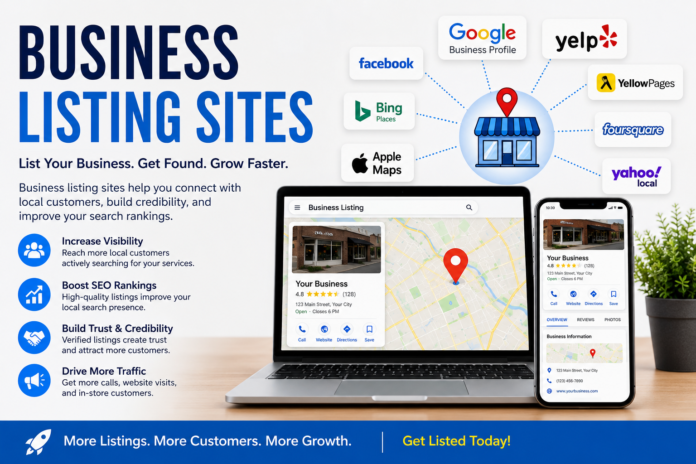

Business Listing Sites In today’s digital world, having a website is important, but it is not always enough to help people discover your business. When customers search for a local service, company, shop, restaurant, or professional, they often check business directories and listing platforms before making a decision. This is where business listing sites can make a real difference. They give businesses another way to appear in search results, share important information, build credibility, and connect with potential customers.
Business listing sites are online directories where companies can create profiles containing details such as their business name, address, phone number, website, services, opening hours, photos, and customer reviews. Some platforms are general directories, while others focus on specific industries or locations. When used correctly, these listings can support a broader SEO strategy and help businesses strengthen their online presence.
The good news is that creating business listings does not have to be complicated. With accurate information, consistent branding, useful descriptions, and a smart approach to reviews, even a small business can use online directories to become easier to find. In this guide, we will explain what business listing sites are, why they matter for SEO, how to choose the right directories, and how to create listings that provide real value.
What Are Business Listing Sites?
Business listing sites are online platforms that collect and display information about businesses. Think of them as modern versions of traditional business directories, but with many more features. Instead of simply showing a company name and phone number, many platforms allow businesses to publish descriptions, images, service information, customer reviews, maps, website links, and other useful details.
These websites can be especially valuable for local businesses. Someone searching for a nearby dentist, plumber, restaurant, digital marketing agency, clothing store, or repair service may come across a directory profile before visiting the company’s website. A complete listing can give that person enough information to decide whether the business is worth contacting.
There are also business listing sites designed for particular industries, countries, cities, or professional categories. This means businesses do not necessarily need to submit their information to every directory they find. A smaller number of relevant and trustworthy listings can be more useful than hundreds of low-quality profiles.
Why Are Business Listing Sites Important for SEO?
One of the biggest reasons businesses use listing sites is to improve their online visibility. Search engines need reliable information to understand what a business does and where it operates. Consistent information across reputable websites can help create a stronger digital footprint.
Business listings can also help people discover a company through searches beyond its own website. For example, a customer may search for “best web design company near me” and find a directory page featuring several agencies. If your business has a well-optimized profile on that platform, you have another opportunity to attract that customer.
Listings can also contribute to referral traffic and brand awareness. Not every benefit of a directory comes directly from rankings. A person might see your company on a business directory, visit your website later, search for your brand name, or contact you using the information shown on the listing. In other words, business directories can support several parts of your digital marketing strategy at the same time.
Benefits of Using Business Listing Sites
Better Online Visibility
A major advantage of business listing sites is that they provide additional places where customers can find your company. Instead of depending entirely on your website, you can build a presence across relevant directories and platforms.
This can be particularly helpful for smaller businesses that are competing against established brands. A directory profile may rank for searches related to your business category, location, or services, giving your company another opportunity to appear in front of potential customers.
The key is relevance. A listing on a trusted directory related to your industry or local area is generally more useful than a profile created on an unrelated website simply for the sake of getting another link.
More Opportunities for Local Customers
Local businesses can benefit significantly from online listings. Customers often want quick information such as location, opening hours, phone numbers, directions, and reviews. A good listing puts these details in one convenient place.
For example, if someone searches for a bakery in their city, they may compare several businesses before choosing one. Profiles with accurate information, quality photographs, positive reviews, and clear service descriptions can make the decision easier.
This is why local SEO and business listings often work well together. Your website, local presence, and directory profiles should provide consistent information and reinforce the same business identity.
Increased Trust and Credibility
People are naturally more comfortable dealing with businesses that appear legitimate and established. Having accurate profiles on reputable platforms can help strengthen that first impression.
Customer reviews can add another layer of credibility. Genuine feedback gives potential customers an idea of what they can expect from your products or services. A business should never try to manipulate reviews, but it should make it easy for satisfied customers to share honest feedback.
A professional profile also signals that the business takes its online presence seriously. Complete information, updated photographs, working website links, and professional descriptions can make a noticeable difference.
Potential Referral Traffic
Business directories can send visitors directly to your website. Someone reading your listing may want to learn more about your services and click through to your site.
This type of traffic can be valuable because the visitor already has an interest in what you offer. Unlike random traffic, directory visitors often arrive with a specific need or question.
To get the most from referral traffic, make sure the page you link to is useful and relevant. If your listing promotes web design services, for example, sending visitors to a page specifically about your web design services is usually more helpful than sending everyone to a generic homepage.
How Business Listings Help Local SEO
Local SEO focuses on helping businesses become more visible to customers searching within a particular geographic area. Business listing sites can support this process by distributing important business information across the web.
One important factor is consistency. Your business name, address, phone number, website, and other core details should be accurate and consistent wherever your business appears. Small differences can sometimes create confusion for customers and search engines.
Listings can also reinforce your business category and location. If a company consistently describes itself as a “family dental clinic in Lahore,” for example, relevant directory profiles can help establish that business context. However, businesses should write naturally rather than filling descriptions with repeated keywords.
What Information Should a Business Listing Include?
A strong business listing should answer the questions customers are most likely to ask. At a minimum, consider including:
- Business name
- Physical address, if applicable
- Phone number
- Website
- Business category
- Services or products
- Opening hours
- Business description
- High-quality photographs
- Service areas
- Social media profiles
- Customer reviews
- Location or map information
The exact fields will vary from one platform to another. Use every relevant field that genuinely applies to your business, but avoid adding information simply to make the profile look longer.
Your description should be clear and customer-focused. Explain what your company does, who you serve, what makes your service useful, and where you operate. Avoid stuffing the same keyword into every sentence.
How to Choose the Best Business Listing Sites
Not every directory deserves your time. Before creating a listing, look at the platform carefully.
First, consider relevance. An industry-specific directory may be more useful than a general directory because the visitors are already interested in your type of business. For local companies, directories that focus on the target city, region, or country can also be valuable.
Next, consider the platform’s quality. Look for websites that have real businesses, useful information, clear policies, and genuine user activity. Be cautious with directories that look outdated, contain large amounts of spam, or promise unrealistic SEO results.
Finally, consider whether the listing can actually help your customers. If a directory has no meaningful audience and does not provide a useful business profile, spending hours creating a listing may not be worthwhile.
Free vs. Paid Business Listing Sites
Many business listing platforms offer free profiles, while others provide paid upgrades. Free listings can be a good starting point, especially for small businesses with limited marketing budgets.
Paid listings may offer additional features such as enhanced profiles, advertising opportunities, lead generation, analytics, or greater visibility. However, paying for a listing does not automatically mean it will improve your SEO.
Before spending money, ask what you are actually receiving. If the platform has a relevant audience and the additional features can generate customers, a paid option may make sense. If the only benefit is a vague promise of “instant rankings,” it is better to be cautious.
Common Mistakes to Avoid
One of the most common mistakes is creating incomplete profiles. A listing with only a business name and phone number does not give customers much reason to choose you. Add useful information, photos, services, and other relevant details whenever the platform allows it.
Another mistake is using inconsistent business information. If your phone number, address, or business name changes, update your important listings. Outdated information can frustrate customers and weaken the reliability of your online presence.
Businesses should also avoid creating hundreds of low-quality listings just to build backlinks. Modern SEO is not simply a numbers game. A smaller collection of relevant, trustworthy, and well-maintained profiles can provide more value than a huge collection of spammy directory links.
How to Optimize Your Business Listings for SEO
Start by choosing the correct business category. Categories help platforms understand what your company does and can influence how your profile appears in relevant searches.
Next, write a natural business description. Include your main services, location, and important selling points where appropriate, but write for humans first. A description that sounds natural is much more useful than one packed with repeated keywords.
Images are also important. Add clear photographs of your storefront, products, team, office, completed projects, or other relevant visuals. Keep the images professional and make sure they represent your actual business.
Finally, keep your profiles updated. If your opening hours change during holidays, your phone number changes, or you add a new service, update your listings rather than allowing old information to remain online.
Business Listing Sites and Backlinks
Business directories can sometimes provide links to a company’s website. These links can contribute to referral traffic and may be part of a broader link profile.
However, it is important not to treat every directory link as an SEO shortcut. Search engines evaluate links based on many factors, and low-quality or manipulative link-building practices can create problems.
The better approach is to build listings because they are useful and relevant, with the link acting as an additional benefit. Focus on directories where potential customers could realistically discover your company.
How Reviews Can Strengthen Your Listing
Reviews are one of the most influential parts of many business profiles. Potential customers often look at ratings and read recent comments before contacting a company.
Encourage customers to leave honest feedback after a positive experience, but never pressure people to provide a specific rating or write a fake review. Authentic feedback is more valuable for long-term reputation.
It is also important to respond professionally to reviews. Thank customers who leave positive feedback and respond calmly to legitimate complaints. A thoughtful response can show potential customers that your Business Listing Sites takes feedback seriously.
Business Listing Sites vs. Social Media
Business directories and social media serve different purposes, although they can complement each other. Social media is generally designed for ongoing communication, content sharing, community building, and brand engagement.
Business listings are often more focused on discovery and essential Business Listing Sites information. A customer searching for a service may want your address, phone number, hours, reviews, and website rather than a stream of social posts.
The strongest strategy can include both. Use listings to make your Business Listing Sites easier to discover and social platforms to build relationships and keep your audience engaged.
A Simple Business Listing Strategy
If you are starting from scratch, do not try to submit your Business Listing Sites everywhere at once. Begin with the most relevant and trusted platforms for your location and industry.
Create a consistent profile using the same core Business Listing Sites information. Add a useful description, relevant categories, quality photographs, services, website details, and other available information.
After your main listings are established, review them periodically. Check for incorrect information, broken links, duplicate profiles, outdated hours, and unanswered reviews. Treat your listings as part of your ongoing digital presence rather than a one-time SEO task.
Final Thoughts
Business listing sites can be a simple but effective part of a modern SEO and digital marketing strategy. They help businesses create more opportunities to be discovered, provide useful information to customers, support local visibility, and build trust through reviews and professional profiles.
The most important thing is quality. You do not need to create profiles on every directory available online. Instead, focus on relevant, trustworthy platforms where your target customers are likely to search. Keep your Business Listing Sites information accurate, use natural descriptions, add useful images, and maintain your profiles over time.
When business listings are combined with a strong website, local SEO, helpful content, genuine customer reviews, and a consistent brand presence, they can become a valuable part of long-term online marketing. SEO rarely depends on one single tactic. A well-managed collection of useful business listings is one more way to help the right people find your Business Listing Sitess when they are ready to take action.
FAQs About Business Listing Sites
What are business listing sites?
Business listing sites are online directories where companies can publish information such as their name, address, phone number, website, services, Business Listing Sites hours, photos, and reviews.
Are business listing sites good for SEO?
Yes, relevant and trustworthy business listings can support SEO by improving online visibility, providing referral opportunities, reinforcing business information, and supporting local search efforts.
Are free business listing sites useful?
Yes. Free listings can be useful when the platform is reputable and relevant to your industry or target location. Quality and relevance matter more than simply having a large number of listings.
How many business listing sites should I use?
There is no fixed number that works for every business. Start with the most relevant and reputable directories for your industry and location, then expand when additional platforms provide a genuine benefit.
Should business information be the same on every listing?
Your core business information should be accurate and consistent across important listings. Pay particular attention to your Business Listing Sites name, address, phone number, website, and other essential contact details.
You May Also Read: Myntra Tracking