
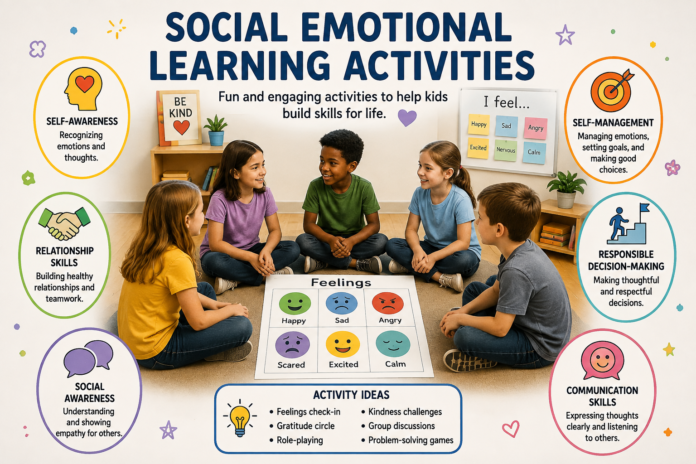

Social emotional learning activities help students develop important life skills that go beyond traditional academic subjects. Skills such as understanding emotions, managing stress, building healthy relationships, showing empathy, making responsible decisions, and communicating clearly can influence how students learn and interact with others. When these skills are practiced regularly, students can become more confident, cooperative, and prepared to handle everyday challenges.
The good news is that social emotional learning, often called SEL, does not have to feel like another difficult lesson. Teachers can introduce SEL through simple conversations, games, creative projects, classroom routines, and short reflection exercises. These activities can fit naturally into the school day without requiring expensive materials or complicated preparation.
Whether you teach elementary students, middle school students, or teenagers, there are many ways to make SEL practical and enjoyable. The key is to create a supportive environment where students feel comfortable expressing themselves, listening to others, and learning from their experiences. Below are some engaging Social Emotional Learning Activities emotional learning activities that teachers, parents, and educators can use in different learning environments.
What Is Social Emotional Learning?
Social emotional learning is the process of helping students develop the knowledge, attitudes, and skills they need to understand themselves and interact positively with other people. It includes areas such as self-awareness, self-management, Social Emotional Learning Activities awareness, relationship skills, and responsible decision-making. These abilities are useful in the classroom, at home, with friends, and later in professional life.
SEL is not simply about asking students to “be nice.” It gives them practical tools for recognizing emotions, handling difficult situations, communicating their needs, solving problems, and considering how their actions affect others. For example, a student who learns to recognize frustration may become better at taking a pause before reacting to a difficult situation.
Another important part of SEL is that it works best when it becomes part of everyday learning. A teacher does not necessarily need a separate hour-long lesson every day. A five-minute check-in, a short discussion after a group activity, or a reflection question at the end of class can provide valuable opportunities for students to practice these skills.
Why Are Social Emotional Learning Activities Important?
Students experience many emotions during a typical school day. They may feel excited about an activity, nervous before a test, disappointed after making a mistake, or frustrated during a disagreement with a classmate. Without appropriate strategies, these emotions can make it harder to concentrate, communicate, or participate in class. SEL activities give students opportunities to understand and manage these experiences in constructive ways.
SEL can also support stronger classroom relationships. When students learn to listen actively, recognize different perspectives, and communicate respectfully, group work can become easier. They may also become more comfortable asking for help or expressing concerns. These skills can contribute to a classroom culture where students feel respected and included.
The benefits of SEL extend beyond school. Emotional awareness, empathy, communication, and responsible decision-making are useful throughout life. A student who learns how to handle disagreement respectfully can use the same basic skill with friends, family members, teammates, and future coworkers. This makes SEL an important part of preparing young people for everyday life, not just academic success.
1. Daily Feelings Check-In
A feelings check-in is one of the simplest Social Emotional Learning Activities emotional learning activities to introduce. At the beginning of class, ask students to describe how they are feeling using a word, number scale, or simple emotion chart. Students can participate verbally, write their response privately, or choose an emotion card if they do not want to speak in front of everyone.
The purpose is not to force students to share personal information. Instead, the activity gives them a chance to pause and notice their emotional state. Teachers can model this by using simple language such as, “I am feeling focused today,” or “I feel a little tired, so I am going to take a moment to get organized.”
Over time, regular check-ins can help students become more aware of their emotions. Teachers may also notice patterns that can help them understand when students need additional encouragement, a short break, or a different approach to an activity.
2. Emotion Charades
Emotion charades turn emotional vocabulary into an interactive classroom game. Prepare cards with different emotions such as happy, worried, surprised, frustrated, proud, calm, disappointed, or excited. One student chooses a card and acts out the emotion without saying the word while classmates try to identify it.
After the emotion has been guessed, ask students what clues helped them recognize it. They might mention facial expressions, body language, posture, or actions. This discussion helps students understand that emotions can be communicated in different ways.
Teachers can make the activity more meaningful by asking students to think about situations that might cause each emotion. The goal is not to assume that everyone responds to an emotion in exactly the same way, but to encourage students to recognize that people can experience and express feelings differently.
3. Gratitude Journal
A gratitude journal gives students a regular opportunity to focus on positive experiences and appreciate people, moments, or things that matter to them. Students can write two or three things they are thankful for at the beginning or end of the school day.
The activity does not need to focus only on major events. Students might write about a helpful classmate, an interesting lesson, time spent with family, a favorite hobby, or a small moment that made them smile. Keeping the activity simple makes it easier to maintain as a classroom routine.
Teachers should avoid turning gratitude into forced positivity. Students can have difficult days and still participate honestly. The purpose is to help students notice positive experiences while recognizing that uncomfortable emotions are also a normal part of life.
4. Kindness Challenge
A classroom kindness challenge encourages students to look for opportunities to support others. Create a list of simple actions, such as thanking someone, helping a classmate, including someone in a group activity, giving a genuine compliment, or helping organize classroom materials.
Students can complete one action each day or work toward a weekly goal. The focus should be on genuine kindness rather than competition. If students receive points or rewards, make sure the system does not turn kindness into a popularity contest.
After the challenge, invite students to reflect on what they noticed. Ask questions such as, “How did your action affect someone else?” and “How did you feel after helping someone?” This connects behavior with emotional awareness and empathy.
5. Role-Playing Real-Life Situations
Role-playing gives students a safe way to practice communication and problem-solving. Teachers can present age-appropriate situations such as two students wanting the same item, a disagreement during group work, someone being left out of an activity, or a student feeling nervous about asking for help.
Students can act out the situation and experiment with different responses. The teacher can then discuss which approaches were respectful, which ones could make the problem worse, and what other choices might be available.
Role-playing is particularly useful because students are practicing skills rather than simply hearing about them. They learn how tone of voice, word choice, listening, and patience can influence the outcome of a difficult situation.
6. The Empathy Circle
An empathy circle is a structured discussion in which students take turns sharing perspectives. The teacher can provide a simple scenario and ask students how different people involved might feel.
For example, a scenario might involve a student who is not selected for a team activity. One student might feel disappointed, another student might feel responsible, and someone watching the situation might feel uncomfortable. Discussing these different perspectives shows students that one event can create different emotions for different people.
The teacher should remind students that empathy does not mean automatically agreeing with another person. It means trying to understand what someone else may be experiencing. This distinction can help students become better listeners and more thoughtful communicators.
7. Personal Strengths Activity
Ask students to create a list of personal strengths. These might include creativity, patience, curiosity, teamwork, honesty, determination, humor, organization, or willingness to help others. Students can then choose three strengths and explain how they use them in everyday situations.
This activity supports self-awareness because students are encouraged to think about what they can do well. Some students may initially struggle to identify their strengths, so teachers can provide examples and allow them to recognize strengths through observations from classmates or adults.
The activity can also be connected to future goals. Students might discuss how their strengths could help them complete a project, overcome a challenge, work with a team, or learn a new skill.
8. Calm-Down Strategy Cards
Create a collection of simple strategy cards that students can use when they need to regain focus. Cards might suggest taking a short pause, practicing slow breathing, stretching, getting a drink of water, writing down a concern, or asking an adult for help.
The cards should be presented as options rather than mandatory solutions. Different strategies work for different people, and students can learn through experience which approaches help them return to a calmer and more focused state.
Teachers can introduce the cards during calm moments rather than waiting until a student is already overwhelmed. Practicing strategies ahead of time makes it easier for students to remember them when they actually need them.
9. Team-Building Challenges
Team-building activities help students practice cooperation, communication, patience, and problem-solving. A simple challenge might require small groups to build something from classroom materials, solve a puzzle, organize information, or complete a creative task together.
The important part is not whether the team finishes first. After the activity, discuss how the group communicated, whether everyone had an opportunity to contribute, and how disagreements were handled.
Teachers can ask students to identify one behavior that helped their team and one behavior they would improve next time. This turns a fun activity into a practical SEL lesson.
10. Problem-Solving Steps
Teach students a simple process for handling everyday problems. One useful approach is to identify the problem, think of possible choices, consider the consequences, choose an appropriate response, and reflect on the result.
Students can practice the process using fictional classroom situations. For example, they might discuss what to do when a group member is not participating in a project or when two students disagree about how to complete an assignment.
Repeated practice helps students understand that problems do not always have one perfect answer. Good decision-making often involves considering several options and thinking about how each choice could affect themselves and other people.
11. Compliment Circle
In a compliment circle, students give respectful and specific compliments to classmates. Instead of simply saying, “You’re nice,” students can mention a helpful action, creative idea, effort, or positive contribution.
Teachers should establish clear guidelines so compliments remain appropriate and sincere. Students should never be pressured to comment on someone’s appearance. Focusing on actions, character, effort, and contributions keeps the activity meaningful.
This activity can also help students recognize positive qualities in others. When practiced respectfully, it encourages appreciation and helps create a classroom environment where students notice and acknowledge one another’s efforts.
12. Emotion Vocabulary Wall
Create a classroom wall featuring different emotion words. Begin with common words such as happy, sad, angry, worried, excited, and calm, then gradually introduce more specific vocabulary such as disappointed, overwhelmed, hopeful, embarrassed, confident, frustrated, or relieved.
A wider emotional vocabulary can make it easier for students to explain how they feel. Instead of saying, “I feel bad,” a student may eventually be able to identify a more specific emotion and communicate what is happening.
Teachers can update the wall throughout the year. Students can contribute new words, examples, or illustrations, making the resource something they actively build together.
13. Reflection After Group Work
Group projects provide natural opportunities for SEL reflection. After completing a group activity, give students a few minutes to consider how the team worked together.
Questions might include: “Did everyone get a chance to speak?” “How did we handle disagreements?” “What helped us stay organized?” and “What could we do differently next time?” Students can answer privately or discuss their responses with the group.
This approach helps students understand that teamwork is a skill that improves with practice. It also encourages them to think about their own behavior rather than simply blaming others when something goes wrong.
14. Story-Based SEL Discussions
Stories are excellent tools for exploring emotions and relationships. After reading an age-appropriate story, ask students about the characters’ choices, feelings, challenges, and relationships.
Instead of focusing only on what happened, encourage students to consider why a character might have acted a certain way. Ask what other choices the character could have made and how those choices might have changed the outcome.
Story discussions allow students to explore emotional situations without having to talk directly about their own experiences. This can make difficult topics easier to discuss while still developing empathy and decision-making skills.
15. SEL Exit Tickets
An SEL exit ticket is a short reflection students complete before leaving class. It might contain one question such as, “What is one thing you learned about yourself today?” or “What helped you work well with others?”
The activity can take less than five minutes and can be completed on paper or digitally. Teachers can review responses to understand how students are experiencing classroom activities.
Exit tickets also encourage students to pause and reflect instead of immediately moving from one activity to another. With consistent use, they can become a simple but valuable part of the classroom routine.
How to Make Social Emotional Learning Activities More Effective
The most effective SEL activities are consistent, age-appropriate, and connected to real situations. Students should have repeated opportunities to practice skills rather than completing one activity and moving on. A short activity used regularly can be more valuable than a complicated lesson used only once.
It is also important to create a classroom environment where students feel respected. Teachers should avoid forcing students to reveal private experiences. Students need to understand that they can participate in many SEL activities without sharing information they are uncomfortable discussing publicly.
Finally, adults should model the behaviors they expect from students. Teachers can demonstrate respectful communication, patience, active listening, and appropriate emotional expression. Students learn not only from SEL lessons but also from the way adults respond to everyday challenges.
Social Emotional Learning Activities by Age Group
For younger children, SEL activities should generally be simple, visual, interactive, and short. Emotion cards, stories, drawing exercises, role-playing, movement games, and feelings check-ins can work particularly well because young students are still developing emotional vocabulary.
Middle school students often benefit from activities that connect SEL to friendships, teamwork, decision-making, school pressure, communication, and personal goals. Scenario discussions, journaling, group challenges, and problem-solving exercises can give them opportunities to explore increasingly complex Social Emotional Learning Activities situations.
Older students can participate in deeper discussions about communication, responsibility, relationships, conflict resolution, leadership, goal setting, and future challenges. Reflection activities can encourage them to consider how their decisions affect themselves and the people around them.
Common Mistakes to Avoid With SEL
One common mistake is treating SEL as a reward or punishment system. Emotional skills are not simply behaviors that students should perform to earn points. The goal is to help students develop genuine understanding and practical skills that they can use independently.
Another mistake is expecting every student to respond to an activity in the same way. Students have different personalities, experiences, communication styles, and comfort levels. Providing multiple ways to participate can make SEL more inclusive and effective.
Teachers should also avoid turning every emotional moment into a lesson. Sometimes a student simply needs to be heard and supported. SEL works best when it balances instruction with genuine human connection.
Final Thoughts on Social Emotional Learning Activities
Social Emotional Learning Activities emotional learning activities can become a valuable part of everyday education without making the school day feel overloaded. From simple feelings check-ins and gratitude journals to role-playing, teamwork challenges, and empathy discussions, small activities can give students regular opportunities to practice important life skills.
The most successful approach is usually consistent rather than complicated. Teachers can choose a few activities that fit their students and classroom environment, then gradually introduce new ones. With regular practice, students can become more comfortable identifying emotions, communicating respectfully, solving problems, cooperating with others, and making thoughtful decisions.
Ultimately, SEL is about helping students understand themselves while learning how to navigate the world around them. Academic knowledge is important, but students also need confidence, empathy, communication skills, resilience, and good judgment. By making Social Emotional Learning Activities emotional learning a natural part of classroom life, educators can help students develop skills that remain useful long after they leave school.
You May Also Read: School AI Chatbot