
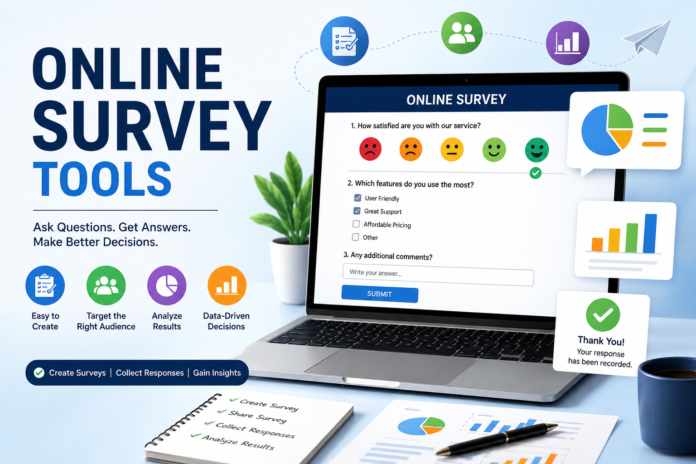

Online surveys have become one of the easiest ways for businesses, researchers, educators, marketers, and organizations to collect useful information from people. Instead of printing questionnaires, handing out forms, and manually entering answers, you can now create a survey online, share a link, and collect responses automatically. This makes the entire process faster, more organized, and often much more affordable.
The growing popularity of online survey tools has also made surveys more flexible. Modern platforms can handle everything from a simple customer feedback form to a detailed research questionnaire with multiple sections, conditional questions, rating scales, and automated reports. The right tool can help you understand what your audience thinks and turn those responses into information you can actually use.
In this guide, we will explore what online survey tools are, how they work, their key features, major benefits, common use cases, and how to choose the right platform for your needs.
What Are Online Survey Tools?
Online survey tools are web-based platforms that allow users to create, distribute, and analyze surveys digitally. Most tools provide a visual survey builder, meaning you can create questions without needing programming or technical skills. Depending on the platform, you may be able to add multiple-choice questions, text responses, rating scales, checkboxes, dropdown menus, and other question types.
Once a survey is ready, it can usually be shared through a direct link, email, social media, a website, or a QR code. Participants can complete the survey using a computer, tablet, or smartphone. Their responses are then stored automatically inside the platform, which saves time compared with collecting and organizing paper forms.
The most useful part is often the reporting system. Many online survey tools can turn responses into charts, graphs, summaries, and downloadable reports. Instead of spending hours sorting through individual answers, users can quickly identify patterns and make decisions based on the collected information.
Why Are Online Survey Tools So Popular?
One major reason online surveys are popular is convenience. A survey can be created and distributed without printing hundreds of pages or organizing physical meetings. Participants can respond whenever it is convenient for them, which can make it easier to reach people in different locations and time zones.
Another advantage is speed. Traditional surveys can take considerable time to distribute and collect. Online surveys can begin collecting responses almost immediately after the survey link is shared. This is particularly helpful when a company needs quick feedback about a product, service, event, or customer experience.
Online survey tools also make data easier to manage. Responses are generally collected in a centralized dashboard, reducing the need for manual data entry. Many platforms also offer export options, allowing users to move their data into spreadsheets or other analysis systems when more detailed research is required.
Key Features to Look for in Online Survey Tools
When comparing online survey tools, the survey builder should be one of the first things you examine. A good builder should make it easy to add, remove, reorder, and edit questions. Drag-and-drop functionality can make the process even simpler, especially for users who do not have technical experience.
Customization is another important feature. A professional survey should feel appropriate for the organization or project behind it. Some platforms allow users to add logos, change themes, customize colors, and adjust layouts. These options can make a survey feel more trustworthy and consistent with a brand’s identity.
Logic and automation features are also valuable for more advanced surveys. For example, a survey can show different questions depending on a participant’s previous answer. This can prevent people from seeing questions that are irrelevant to them and create a more personalized experience.
Types of Questions You Can Create
Online survey tools usually support several question formats. Multiple-choice questions are useful when respondents need to select one or more predefined answers. They are easy to complete and relatively simple to analyze.
Rating questions are another common option. A business might ask customers to rate their experience on a scale, while a researcher could use a scale to measure attitudes or opinions. Ranking questions can also help respondents prioritize products, features, ideas, or preferences.
Open-ended questions allow participants to provide answers in their own words. These questions can reveal details that fixed-answer questions may miss. However, they can take longer to analyze because responses may contain different wording, opinions, and levels of detail.
Benefits of Using Online Survey Tools
The biggest benefit is efficiency. Creating and distributing a digital survey can be considerably faster than preparing a traditional questionnaire. Automated response collection also reduces repetitive administrative work.
Cost is another important factor. Businesses and organizations can often collect feedback without paying for printing, postage, or manual data-entry services. Many platforms offer free plans or affordable entry-level options, although advanced features may require a paid subscription.
Online surveys can also improve accessibility. Participants can often answer questions from their own devices without traveling to a particular location. This makes it possible to collect feedback from a broader audience and conduct research across different geographic areas.
How Businesses Use Online Survey Tools
Businesses commonly use surveys to understand customer satisfaction. After a purchase or support interaction, a company may ask customers about their experience. The results can highlight areas that are working well and identify problems that need attention.
Market research is another important application. Before launching a product, a company may survey potential customers about their preferences, expectations, or purchasing habits. This information can help businesses understand their target market before investing heavily in a new idea.
Employee feedback is also increasingly important. Organizations can use surveys to understand workplace experiences, gather opinions about internal processes, and identify areas where employees believe improvements could be made. Anonymous surveys can sometimes encourage people to provide more honest feedback.
Online Surveys for Education and Research
Teachers and schools can use online survey tools for classroom feedback, course evaluations, and student questionnaires. A teacher might ask students which parts of a lesson were most useful or where they experienced difficulties. The results can provide practical information for improving future lessons.
Researchers can also use survey platforms to collect structured data from participants. Depending on the research design, online questionnaires can make it easier to reach a large number of respondents. Researchers should still pay close attention to sampling, question wording, privacy, and data quality.
Universities and other educational institutions can use surveys for broader purposes as well. They may collect feedback about courses, campus services, events, or student experiences. Because responses are stored digitally, analyzing large collections of feedback can be more manageable.
How to Choose the Right Online Survey Tool
The best online survey tool depends on what you actually need. A person creating a simple feedback form probably does not need the same features as a professional researcher conducting a complex study. Start by identifying the purpose of the survey and the features that are genuinely necessary.
Consider the number of questions and responses you expect to collect. Free plans may work well for small projects, while larger campaigns may require higher response limits. Check the pricing structure carefully because some platforms charge based on responses, users, features, or other limits.
Ease of use should also be considered. A platform with dozens of advanced features may look impressive, but it can become frustrating if the basic survey-building process is complicated. If several people will work on the same project, collaboration features and user permissions may also be important.
Data Analysis and Reporting
Collecting responses is only half the job. The real value of a survey comes from understanding what those responses mean. Good online survey tools provide dashboards that help users review results without manually organizing every response.
Charts and graphs can make trends easier to identify. For example, a customer satisfaction survey might reveal that most respondents are happy with product quality but less satisfied with delivery speed. Seeing those patterns visually can make the results easier to communicate to a team.
For more advanced analysis, users may want to export survey responses into spreadsheet or statistical software. This provides greater flexibility for filtering information, comparing groups, calculating results, and conducting more detailed research.
Tips for Creating Better Online Surveys
A good survey should be easy to understand. Avoid complicated wording, unnecessary jargon, and questions that could confuse respondents. Each question should have a clear purpose, and participants should be able to understand exactly what is being asked.
Keep the survey as focused as possible. Long questionnaires can become tiring, especially when many questions repeat the same idea. If a question does not contribute meaningful information, consider removing it.
It is also important to test the survey before sending it to a large audience. Complete it yourself and ask someone else to test it as well. Look for spelling mistakes, confusing questions, broken logic, missing answer choices, and problems on mobile devices.
Common Mistakes to Avoid
One common mistake is asking leading questions. A question should not push respondents toward a particular answer. Neutral wording gives participants a better opportunity to express what they genuinely think.
Another problem is using too many mandatory questions. If respondents are forced to answer questions that do not apply to them, they may become frustrated or abandon the survey. Where appropriate, include options such as “Not applicable” or allow certain questions to remain optional.
Ignoring privacy can also damage trust. Survey creators should clearly communicate how responses will be used, particularly when collecting sensitive or personally identifiable information. Organizations should follow applicable privacy and data-protection requirements when designing and managing surveys.
Online Survey Tools vs. Traditional Surveys
Traditional surveys still have their place, especially in situations where internet access is limited or a specific audience is more comfortable with paper forms. However, Online Survey Tools surveys are generally more convenient when respondents have reliable access to digital devices.
Paper surveys require manual distribution and often require someone to enter the answers into a digital system later. Online Survey Tools tools can automate much of this process. That can reduce administrative work and lower the chance of mistakes caused by manual data entry.
Online surveys also offer greater flexibility. Questions can be updated, responses can be monitored, and results can often be analyzed from a central dashboard. For organizations that regularly collect feedback, these advantages can make digital surveys a practical long-term solution.
Final Thoughts on Online Survey Tools
Online Survey Tools survey tools have changed the way organizations collect and understand feedback. From customer satisfaction and market research to education and employee feedback, these platforms provide a convenient way to gather information from people without relying on traditional paper questionnaires.
The best tool is not necessarily the one with the longest feature list. Instead, look for a platform that matches your goals, budget, audience, response volume, and technical requirements. A simple project may only need an easy survey builder and basic reporting, while a larger research project may require advanced logic, collaboration, data exports, and detailed analytics.
Ultimately, successful surveying depends on more than choosing software. The questions themselves need to be clear, relevant, unbiased, and purposeful. When a well-designed questionnaire is combined with the right Online Survey Tools survey tool, the result can be valuable information that supports better decisions and meaningful improvements.
Frequently Asked Questions
What are online survey tools used for?
Online Survey Tools survey tools are used to create and distribute digital questionnaires and collect responses. Businesses, schools, researchers, marketers, and organizations can use them for feedback, research, evaluations, customer satisfaction, and many other purposes.
Are online survey tools easy to use?
Most modern platforms are designed for users without technical experience. Visual builders, templates, drag-and-drop features, and automated reporting can make the process relatively straightforward.
Can online surveys be completed on mobile phones?
Yes. Many modern survey platforms support mobile-responsive questionnaires, allowing participants to answer using smartphones and tablets. It is still a good idea to test the survey on different screen sizes before publishing it.
How can I get more people to complete my survey?
Keep the questionnaire focused, explain why the feedback matters, use clear language, and avoid unnecessary questions. Sharing the survey through the communication channel your audience already uses can also improve participation.
What makes an online survey effective?
An effective survey has a clear purpose, simple questions, logical organization, appropriate answer choices, and a reasonable length. Testing the survey before sending it to your full audience can also help identify problems and improve the overall response experience.
You May Also Read: Valentin Balthasar