
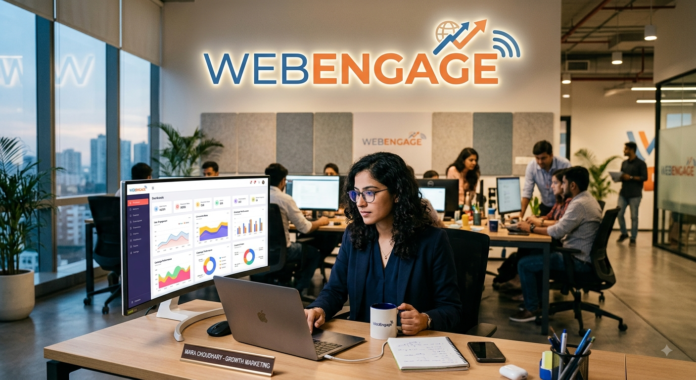

What Is WebEngage?
WebEngage is a customer engagement and retention platform designed to help businesses communicate with their customers in a more personalized and meaningful way. Instead of treating every customer the same, the platform uses customer data and behavior to help brands understand what people are doing and decide when, where, and how to communicate with them.
The company was founded in 2011 and has developed from a marketing automation product into a broader customer engagement and retention platform. According to WebEngage, more than 850 enterprises use its platform, with hundreds of millions of monthly active users engaged through the service.
The basic idea behind WebEngage is fairly simple: businesses should not have to rely on guesswork when communicating with customers. If a customer has viewed a product, abandoned a shopping cart, installed an app, or stopped interacting with a service, those actions can provide useful context for a more relevant marketing message.
How WebEngage Works
WebEngage works by collecting customer information and behavioral signals from websites, mobile applications, and other connected systems. Businesses can integrate their platforms using SDKs, APIs, Google Tag Manager, Segment, and other supported methods. Once the integration is completed, businesses can track user attributes and events.
This information helps create a broader picture of each customer. For example, a retailer may know that a particular visitor looked at several products but did not purchase anything. Rather than sending that person a generic promotional message, the business can use the available behavioral information to create a more relevant campaign.
The platform then connects customer data with engagement channels. Businesses can create campaigns, build automated journeys, segment users, personalize messages, and analyze results. This makes WebEngage more than just a tool for sending notifications because it connects customer understanding, campaign execution, and measurement in one environment.
Key Features of WebEngage
One reason WebEngage has attracted businesses across different industries is its broad collection of customer engagement features. The platform combines customer data, analytics, segmentation, campaign management, automation, and personalization.
Its engagement capabilities include channels such as push notifications, in-app messages, SMS, email, web push, on-site notifications, WhatsApp, and Facebook retargeting. WebEngage’s documentation also highlights RCS among its supported engagement channels.
Another important feature is campaign orchestration. Marketers can create workflows based on customer actions and business rules. Instead of manually sending every message, teams can create automated experiences that respond to specific events or changes in customer behavior.
The platform also includes analytics and segmentation tools. These features allow marketers to study customer behavior, create targeted groups, test campaigns, and measure outcomes such as clicks, conversions, revenue, and other engagement indicators.
WebEngage Customer Data Platform
Customer data can become complicated as a business grows. Information may come from a website, mobile application, advertising platform, CRM system, or other tools. When these systems operate separately, marketers can struggle to understand the complete customer journey.
WebEngage’s Customer Data Platform is designed to bring information from different sources together and create a unified customer view. The company’s platform materials describe capabilities for collecting data, unifying profiles, segmenting users, protecting information, and activating data for campaigns.
This unified approach can be especially useful for businesses that have customers interacting through several touchpoints. A customer might browse a website on a laptop, open an app later, receive an email, and eventually purchase through another device. Connecting those interactions can give marketers a more complete understanding of the customer’s journey.
The real value comes when businesses use that information responsibly. Data should not simply be collected for the sake of collecting it. The goal should be to turn useful information into better experiences, more relevant communication, and stronger customer relationships.
Omnichannel Customer Engagement
Modern customers rarely stay on a single communication channel. Someone might discover a company through social media, visit its website, download its app, receive an email, and communicate through WhatsApp.
This is where omnichannel engagement becomes important. WebEngage allows businesses to work with multiple channels from a broader engagement environment. Its documentation lists push, in-app, SMS, on-site messages and surveys, web push, email, WhatsApp, and Facebook retargeting among its channels.
The advantage of an omnichannel approach is consistency. Instead of creating completely disconnected campaigns for every channel, marketers can design experiences around the customer’s lifecycle. A message can be selected based on the customer’s behavior, preferences, and previous interactions.
For example, an online store could send an email after a customer leaves items in a cart. If the customer still does not return, a different channel could be used later. The purpose is not to bombard the customer with messages but to create a sensible sequence that reflects what the customer actually did.
Personalization and Customer Segmentation
Personalization has become one of the biggest expectations in digital marketing. Customers are more likely to pay attention to content that feels relevant to their interests rather than a generic message sent to everyone.
WebEngage supports segmentation using personal and behavioral information. Its segmentation tools can use factors such as customer actions, demographics, location, technology, and other user data to create more specific audiences.
Consider an e-commerce company with thousands of customers. Sending the exact same message to every customer may not be very effective. Instead, the company could create separate segments for first-time visitors, repeat customers, inactive users, frequent buyers, or people who have interacted with a particular category.
Personalization can then be applied to those segments. A new customer might receive onboarding information, while an existing customer could receive recommendations based on previous interactions. The key is to make communication useful rather than simply adding a customer’s name to a generic message.
Journey Automation With WebEngage
One of WebEngage’s useful capabilities is journey automation. Customer journeys allow marketers to create workflows based on events, conditions, timing, and communication channels.
Imagine that someone creates an account on an online learning platform. Instead of having a marketing employee manually follow up with every new user, the business could create an automated journey. The first message might welcome the user, another could encourage them to complete their profile, and a later message could recommend relevant content.
WebEngage’s platform describes campaign orchestration as a way to create workflows, establish rules, select channels, and run contextual campaigns based on customer and business-triggered events.
Automation becomes even more useful when it is combined with segmentation and analytics. A journey can be adjusted according to what customers actually do. Someone who completes an action can move forward, while someone who does not engage can receive a different experience.
Analytics and Campaign Performance
Sending a campaign is only half the job. The bigger question is whether the campaign actually achieved its goal.
WebEngage provides campaign and product analytics designed to help businesses evaluate customer behavior and campaign performance. Its documentation describes tracking metrics such as deliveries, clicks, conversions, revenue, and uninstalls, along with tools for events, funnels, cohorts, and other behavioral analysis.
This data can help marketers identify what is working and what needs improvement. For example, a campaign may have a high delivery rate but a low conversion rate. That could indicate that the audience, offer, message, timing, or landing experience needs attention.
Testing is another important part of optimization. WebEngage’s documentation describes multivariate testing capabilities that allow marketers to compare different message variations and evaluate their performance.
Who Can Benefit From WebEngage?
WebEngage is particularly relevant to consumer-focused businesses that need to manage customer engagement at scale. Its website highlights industries including e-commerce, education technology, banking and financial services, direct-to-consumer businesses, gaming, travel, and hospitality.
E-commerce companies can use engagement tools to improve customer retention, recover potential purchases, recommend products, and encourage repeat buying. For an online store, understanding what a customer browses and purchases can help create more relevant lifecycle campaigns.
Travel and hospitality businesses can also benefit from customer lifecycle communication. Booking reminders, personalized recommendations, post-purchase communication, and re-engagement campaigns can all be connected to customer behavior.
For subscription or app-based businesses, retention can be equally important. Businesses can use behavioral data to understand when customers become less active and create appropriate engagement journeys instead of waiting until users completely disappear.
Benefits of Using WebEngage
One of the biggest advantages of WebEngage is that it brings several parts of the customer engagement process together. Instead of relying on completely separate systems for data, segmentation, campaigns, personalization, and analytics, businesses can connect these activities within one platform.
Another advantage is personalization. When campaigns are based on actual customer behavior, businesses can move away from mass messaging and toward more relevant communication. This can make marketing feel more useful and less intrusive when it is implemented thoughtfully.
Automation is another major benefit. Marketing teams can build customer journeys once and allow them to operate according to defined rules and events. This can save time while creating more consistent communication.
Finally, analytics gives businesses a way to measure their efforts. Rather than assuming a campaign worked because it was delivered successfully, marketers can examine engagement and conversion data and make decisions based on measurable results.
Is WebEngage Easy to Use?
Ease of use depends on the size and technical requirements of the business. A small team with limited technical knowledge may need some time to understand customer data, integrations, segmentation, and automated journeys.
At the same time, WebEngage positions its platform as marketer-friendly and provides integration and onboarding support. Its official materials describe SDK, API, Google Tag Manager, and Segment integration options, while its company information highlights onboarding and customer success support.
The technical setup is an important part of getting value from any customer engagement platform. Good tracking and clean customer data are essential. If events are configured incorrectly, even an impressive campaign system can produce poor results.
For that reason, businesses should approach WebEngage as part of a broader customer engagement strategy rather than simply another marketing tool. The technology can support the strategy, but the quality of the strategy still depends on understanding customers and setting clear goals.
Final Thoughts
WebEngage has grown into a broad customer engagement and retention platform that combines customer data, analytics, segmentation, personalization, campaign management, and automation. Its focus is not simply on sending more messages but on helping businesses create more contextual interactions throughout the customer lifecycle.
For businesses managing large numbers of customers across websites, apps, and multiple communication channels, having a unified engagement system can make marketing operations more organized. Features such as customer segmentation, automated journeys, omnichannel messaging, and analytics can help teams move from generic campaigns toward more personalized experiences.
However, successful customer engagement is not only about technology. Businesses still need accurate data, thoughtful messaging, appropriate communication frequency, and a clear understanding of what customers actually need. When those elements come together, a platform like WebEngage can become a useful part of a long-term retention and growth strategy.
Frequently Asked Questions About WebEngage
What is WebEngage used for?
WebEngage is used for customer engagement, marketing automation, personalization, segmentation, analytics, and customer retention. Businesses can communicate with users through multiple channels and create automated customer journeys.
Is WebEngage a CRM?
WebEngage is better described as a customer engagement and retention platform with customer data capabilities. It focuses heavily on behavioral data, segmentation, personalization, campaign automation, and lifecycle engagement rather than functioning as a traditional sales CRM.
Which channels does WebEngage support?
WebEngage supports multiple engagement channels, including push notifications, in-app messaging, SMS, email, web push, on-site notifications and surveys, WhatsApp, and Facebook retargeting. Its documentation also describes additional channel capabilities depending on the platform setup.
Can WebEngage personalize customer campaigns?
Yes. WebEngage uses customer attributes and behavioral events to support personalized campaigns and audience segmentation. Marketers can create segments based on information such as behavior, demographics, location, and technology.
Is WebEngage suitable for e-commerce businesses?
Yes. WebEngage specifically offers solutions for e-commerce and direct-to-consumer businesses, including customer engagement, product analytics, campaign analytics, journey automation, and personalized experiences.
You May Also Read: BusinessEra