
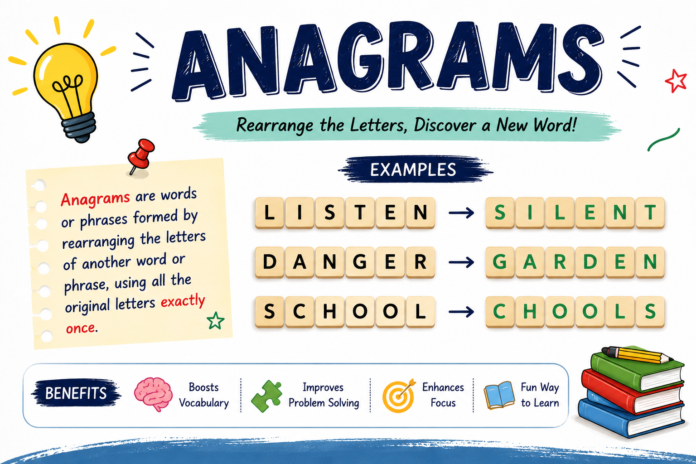

Anagrams are one of those simple word puzzles that can become surprisingly addictive. At first, they may look like nothing more than a jumble of letters, but there is usually a clever word or phrase hiding inside. The basic idea is simple: take the letters from a word or phrase, rearrange them, and create another word or phrase using exactly the same letters. Once you understand the rules, anagrams can become a fun way to improve vocabulary, test your spelling, and challenge your brain.
Whether you enjoy crossword puzzles, word games, Scrabble-style challenges, or simply like playing with language, anagrams offer something interesting. They can be easy enough for beginners but also difficult enough to challenge experienced word lovers. In this guide, we’ll explore what anagrams are, how they work, different types of anagrams, useful examples, and some practical ways to solve them.
What Are Anagrams?
An anagram is a word or phrase created by rearranging the letters of another word or phrase. The important rule is that every letter from the original word must be used, usually exactly once. The order changes, but the collection of letters stays the same. For example, the word “listen” can be rearranged to make “silent.” Both words contain the same six letters, but they appear in a different order.
Anagrams can be made from individual words, multiple words, names, or even longer phrases. Some are created intentionally as puzzles, while others are discovered simply because certain combinations of letters can form several meaningful words. This makes anagrams a fascinating part of wordplay and language.
The beauty of anagrams is their simplicity. You do not need special equipment or advanced knowledge to get started. All you need is a word, a pencil and paper if you want to work traditionally, and a willingness to experiment with different letter combinations.
How Do Anagrams Work?
The first step in creating or solving an anagram is to look carefully at the letters involved. You need to identify how many times each letter appears. This matters because an anagram must normally use the same letters and the same number of times as the original word or phrase.
For example, “evil” can be rearranged to form “vile,” “veil,” or “live.” Each option contains the same four letters: E, V, I, and L. The letters have simply been placed in different positions. This is what makes each one a valid anagram.
When solving a difficult anagram, it helps to avoid focusing too much on the original order of the letters. Instead, think about possible beginnings, endings, common letter combinations, and familiar word patterns. Sometimes recognizing a likely suffix such as “-ing,” “-ed,” or “-tion” can make the answer much easier to discover.
Simple Anagram Examples
One of the easiest ways to understand anagrams is through examples. Consider “heart.” Rearranging its letters gives you “earth.” The meaning changes completely, but the letters remain the same. This is one reason Anagrams can feel almost magical when you discover them.
Another example is “save,” which can become “vase.” Both words use S, A, V, and E. Similarly, “state” can be rearranged into “taste.” These examples are relatively easy because the words are familiar and contain common letter combinations.
Some anagrams can produce more than one alternative word. For instance, “angel” can be rearranged into “glean.” With longer words, the number of possible combinations can increase dramatically, although not every combination will create a real word. The challenge is finding combinations that actually make sense.
Different Types of Anagrams
Word-to-Word Anagrams
The most common type involves rearranging one word to create another word. These are usually the easiest anagrams to understand and are popular in basic word puzzles. Examples include “listen” and “silent” or “night” and “thing.”
Word-to-word anagrams are useful for beginners because they make the basic concept clear. They also provide a quick vocabulary challenge without requiring complicated rules.
Phrase Anagrams
Phrase anagrams involve rearranging the letters of an entire phrase to create another phrase. Spaces and punctuation are generally ignored when checking the letters. These can be much harder because there are more letters to work with.
Phrase anagrams are often used for humorous wordplay, puzzles, and creative writing. Finding a meaningful phrase from a large collection of letters can require considerable creativity and patience.
Name Anagrams
Names can also be turned into anagrams. Writers and puzzle creators sometimes use name Anagrams as a playful way to create fictional names or hidden identities. They can be especially interesting when the resulting name has a completely different sound or personality.
Historically, anagrams have sometimes been used as a way of disguising names or ideas. Today, they are more commonly associated with entertainment, puzzles, and creative language.
Why Are Anagrams So Popular?
Anagrams are popular because they combine language and problem-solving in a very accessible way. You do not need to understand complicated mathematics or follow a long set of instructions. You simply need to work with letters and discover a word hiding within them.
Another reason is the feeling of satisfaction that comes with solving one. A difficult anagram can look completely confusing at first. Then, suddenly, the correct word appears. That small moment of discovery is what keeps many people coming back for another puzzle.
Anagrams are also flexible. They can be used in newspapers, books, classrooms, mobile games, websites, quizzes, and social activities. A simple collection of letters can provide anything from a quick five-second challenge to a much longer puzzle.
Benefits of Solving Anagrams
Solving anagrams can be a useful mental exercise. It encourages you to look at familiar words differently and pay attention to individual letters. Instead of reading a word normally, your brain starts examining its structure and possible combinations.
Anagrams can also support vocabulary development. When you encounter a new word while solving a puzzle, you may remember it more easily because you have actively worked with its letters. This can make word learning feel less like memorization and more like a game.
They can also improve problem-solving skills. A challenging anagram often requires several attempts. You may form one possible combination, realize it does not work, and then try another. This encourages patience, flexibility, and creative thinking.
How to Solve Anagrams More Easily
One useful strategy is to start by counting the letters. If you know exactly what letters you have, you can avoid accidentally adding or removing one. This is especially important with longer words and phrases.
Next, look for common letter combinations. English contains many patterns that appear repeatedly, such as “th,” “ch,” “sh,” “ing,” “tion,” and “er.” Finding one of these combinations can give you a useful starting point.
Another approach is to identify unusual letters. Letters such as Q, X, Z, or J can strongly narrow down the possibilities. If a puzzle contains a rare letter, think about words that commonly use it. You can also try rearranging the vowels first and then fitting the consonants around them.
Finally, do not be afraid to experiment. Anagrams are supposed to involve trial and error. Write down different combinations, move letters around, and look at the possibilities from different angles.
Anagrams in Word Games and Puzzles
Anagrams have become a major part of many popular word games. Games that involve creating words from a set of letters naturally rely on the same basic skill. Players need to recognize possible words and arrange letters efficiently.
Crossword and puzzle enthusiasts also encounter anagrams regularly. Some clues are designed to signal that the answer requires rearranging letters. Once you learn to recognize these clues, solving them becomes much easier.
Online word games have made anagrams even more accessible. Players can now solve quick challenges on computers and mobile devices, often competing against friends or other players. The basic concept remains the same, but digital games can add timers, scoring systems, hints, and difficulty levels.
Common Mistakes When Solving Anagrams
One common mistake is changing one of the letters without realizing it. For example, if the original word contains two E’s, your answer must also contain two E’s. It is easy to overlook repeated letters when working quickly.
Another mistake is becoming too focused on one possible answer. If a combination looks promising but does not form a real word, move on instead of forcing it. Sometimes the correct answer is hiding in a completely different arrangement.
People also sometimes assume that an anagram must produce a familiar word. That is not always the case. Some puzzles use less common vocabulary, names, technical terms, or phrases. If you are solving a difficult puzzle, keeping an open mind can help.
Fun Anagram Ideas to Try
If you want to practice, start with short and familiar words. Try finding anagrams for words such as “stop,” “part,” “care,” “tone,” and “read.” These provide a good introduction because they contain common letters and can produce interesting alternatives.
Once you become comfortable, move on to longer words. Words with six, seven, or eight letters can provide a much bigger challenge. You can also challenge a friend by giving them a word and seeing who can find the most valid anagrams.
For an extra challenge, try creating phrase anagrams. Take a short phrase and rearrange its letters to create something completely different. You may not always find a perfect result, but the process itself can be entertaining and surprisingly creative.
Frequently Asked Questions About Anagrams
What is an anagram in simple words?
An anagram is a word or phrase made by rearranging the letters of another word or phrase. The letters remain the same, but their order changes. For example, “listen” and “silent” are anagrams.
Do anagrams have to use every letter?
In a traditional anagram, yes. Every letter from the original word or phrase should be used, normally with the same number of occurrences. Leaving out or adding a letter would make it an invalid anagram.
Can two phrases be anagrams?
Yes. Anagrams can involve complete phrases as well as individual words. When creating phrase anagrams, spaces and punctuation are generally ignored, while the letters must still match.
Are anagrams good for learning vocabulary?
They can be helpful because they encourage you to examine words closely and discover relationships between letters. Solving them can also introduce you to unfamiliar words in an enjoyable way.
What is the easiest way to solve an anagram?
Start by counting the letters, then look for common combinations, vowels, prefixes, and suffixes. Rearrange the letters systematically rather than randomly, and try several possibilities if the first attempt does not work.
Final Thoughts
Anagrams prove that a small collection of letters can offer a surprisingly large amount of entertainment. By simply changing the order of letters, you can turn one word into another and sometimes create an entirely different meaning. That simple idea is what makes anagrams both easy to understand and difficult to master.
Whether you are solving puzzles for fun, improving your vocabulary, playing a word game, or looking for a creative language challenge, anagrams are worth exploring. Start with short words, practice recognizing common patterns, and gradually work your way toward longer and more complicated puzzles. The more you practice, the faster you will become at spotting the words hidden inside the letters.
Most importantly, enjoy the process. Anagrams are not just about finding the correct answer; they are about seeing language from a different perspective. Sometimes the best part is the moment when a confusing jumble suddenly turns into a word that was sitting there all along.
You May Also Read; Peyton Manning Paris