

Introduction
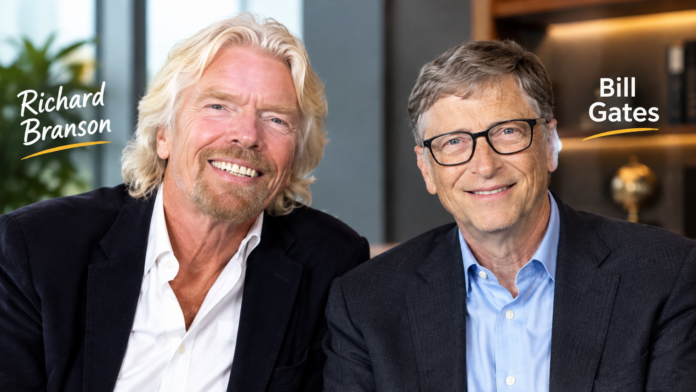
Richard Branson and Bill Gates are two of the most recognizable entrepreneurs in the world. Both built successful businesses, became billionaires, and used their influence to support causes beyond their companies. However, their journeys to success followed very different paths. Branson became famous for building the Virgin brand across industries such as music, aviation, travel, and entertainment, while Gates transformed personal computing through his work at Microsoft.
Their stories offer valuable lessons about ambition, innovation, leadership, and the importance of adapting to change. Although they work in different industries and have distinct personalities, both have demonstrated how a strong idea, careful decision-making, and a willingness to take calculated risks can create lasting influence.
People searching for Richard Branson and Bill Gates often want to understand their relationship, compare their business achievements, explore their fortunes, and discover how they have contributed to society. Looking at their backgrounds and careers reveals why these two entrepreneurs remain important figures in business and philanthropy.
Who Is Richard Branson?
Richard Branson is a British entrepreneur best known as the founder of the Virgin Group. Born on July 18, 1950, in Surrey, England, he developed an interest in business while he was still young. Traditional education was difficult for him, partly because of his dyslexia, but he found other ways to develop his skills and pursue his ambitions.
Branson’s entrepreneurial journey began with a student magazine called Student, which he launched in 1966. The publication gave him an early opportunity to explore marketing, communication, and business management. In 1970, he started a mail-order record business that eventually developed into Virgin Records. What began as a relatively small venture grew into an influential music company that worked with well-known artists.
As his business expanded, Branson moved into industries far beyond music. Virgin became associated with airlines, mobile communications, hospitality, leisure, and space tourism. His willingness to enter established markets and challenge familiar business practices helped him develop a recognizable brand. Rather than building his career around one industry, he pursued opportunities in several areas where he believed customers could receive better service or a different experience.
Branson is also known for his adventurous personality and public image. His ocean-crossing attempts, ballooning adventures, and participation in a Virgin Galactic spaceflight helped make him one of the most recognizable business leaders in the world. Nevertheless, his career has involved financial risks and setbacks as well as major achievements. His story demonstrates that entrepreneurship requires persistence, flexibility, and the ability to learn from unsuccessful ventures.
Who Is Bill Gates?
Bill Gates is an American entrepreneur, software pioneer, and philanthropist. Born on October 28, 1955, in Seattle, Washington, he developed an interest in computers at a young age. His early exposure to programming helped him recognize the potential of computers long before personal computing became a normal part of everyday life.
In 1975, Gates co-founded Microsoft with his childhood friend Paul Allen. Their goal was to develop software for the growing computer industry. As personal computers became more popular, Microsoft expanded its software offerings and became one of the most influential technology companies in the world.
Microsoft’s operating systems and productivity applications played a major role in bringing computing into homes, schools, and workplaces. Products associated with the company, including Windows and Microsoft Office, became familiar to millions of people. Gates helped guide Microsoft’s development through an important period in the growth of the technology industry.
Over time, Gates shifted more of his attention from managing a major technology business to addressing global challenges. He became widely known for supporting public health, education, scientific research, and poverty reduction through philanthropy. He also supports work related to clean energy and technological innovation. His career illustrates how expertise in one industry can provide a foundation for contributing to other areas of society.
How Richard Branson and Bill Gates Became Successful
Richard Branson’s Journey From a Small Business to a Global Brand
Richard Branson and Bill Gates Branson’s success began with a simple idea: find opportunities that other businesses were overlooking and create something customers would enjoy. His early experience in the music industry helped him understand the importance of branding, customer relationships, and building a loyal audience. These lessons later became important as he expanded Virgin into new markets.
One of Branson’s most significant achievements was the development of Virgin Atlantic, which he launched in 1984. The airline entered a competitive industry dominated by established companies. Branson aimed to offer a different travel experience and challenge conventional practices. Building an airline required substantial investment, operational expertise, and the ability to compete against much larger businesses.
Branson’s business philosophy often emphasizes customer experience, employee satisfaction, and a willingness to question established rules. He has also demonstrated that a recognizable brand can help a company enter new industries. However, the Virgin name alone does not guarantee success. Every business still needs a workable strategy, capable leadership, financial discipline, and a clear understanding of its customers.
Bill Gates’s Rise Through Microsoft
Bill Gates followed a different path by concentrating on a technology that was beginning to reshape the world. When he co-founded Microsoft with Paul Allen in 1975, personal computing was still developing. Gates recognized that software would become increasingly important as computers reached more individuals and businesses.
Microsoft’s growth accelerated as demand for personal computers increased. Its operating systems and software applications helped make computers useful for everyday activities, from writing documents to managing business operations. Gates played a major role in Microsoft’s strategy, helping the company establish itself as a leading software provider.
Gates also became known for his analytical thinking, technical knowledge, and competitive approach to business. Microsoft faced substantial competition and legal scrutiny during its expansion, particularly over its market power and business practices. These controversies form an important part of the company’s history and show that commercial success must also be considered alongside competition, regulation, and corporate responsibility.
Richard Branson and Bill Gates: What Is Their Relationship?
Richard Branson and Bill Gates are both influential entrepreneurs who have interacted through business, philanthropy, and international initiatives. Although they built their fortunes in different industries, they share interests in innovation, entrepreneurship, and using private investment to address major global challenges.
Their connection is not simply a matter of two famous billionaires knowing each other. They have participated in overlapping business and philanthropic networks, including initiatives related to climate change and new technologies. Branson has also spoken publicly about knowing Gates personally, including through social occasions and friendly tennis matches. Their relationship reflects the way successful entrepreneurs sometimes work together despite operating separate businesses.
It is important, however, to distinguish between cooperation and joint ownership. Branson founded the Virgin Group, while Gates co-founded Microsoft. They do not jointly own either of these businesses. Their documented collaborations and shared investments show that people with different professional backgrounds can support the same projects without becoming business partners in the traditional sense.
Their Investment in Alternative Meat Technology
One notable example of their shared interests was their investment in Memphis Meats, a company developing cultivated meat using animal cells. In 2017, the company announced a $17 million funding round that included investments from both Gates and Branson, alongside other investors. The project attracted attention because it explored a different approach to producing meat.
Cultivated meat is produced by growing animal cells under controlled conditions rather than raising an entire animal for meat. Supporters believe this technology could eventually offer new ways to address food production, resource use, and animal welfare. However, the environmental benefits and commercial practicality depend on factors such as production methods, energy consumption, manufacturing costs, and the ability to scale up.
Their investment illustrates a shared willingness to explore unfamiliar industries when they see the potential for meaningful change. Neither entrepreneur built his reputation solely by following traditional business models. Both have shown interest in emerging technologies that could develop into important industries over time.
Richard Branson vs. Bill Gates: Key Differences
Business Industries and Strategies
The most obvious difference between Richard Branson and Bill Gates is the type of business each built. Branson developed a diverse group of companies under the Virgin brand. His business interests have included music, aviation, telecommunications, travel, hospitality, and space-related ventures. This diversification allowed the Virgin name to reach customers in several areas of everyday life.
Gates, on the other hand, became famous primarily through software and technology. Microsoft established its position by developing products that became essential tools for personal and professional computing. Rather than relying on a single consumer-facing brand across unrelated industries, Microsoft’s success grew from its software ecosystem, business relationships, and position in the technology market.
These different strategies highlight two approaches to entrepreneurship. Branson’s career demonstrates the potential of brand development and expansion into multiple sectors, while Gates’s career demonstrates the impact of concentrating on a technology with broad applications. Neither approach guarantees success, but both offer useful lessons about identifying opportunities and building a competitive advantage.
Leadership and Personality
Branson is widely associated with an outgoing personality, adventurous challenges, and a relaxed public image. His leadership philosophy often emphasizes empowering employees, listening to customers, and making business more enjoyable. His public adventures have also helped him attract attention to the Virgin brand and its projects.
Gates became known for his analytical approach, attention to technical details, and intense focus on competition. During Microsoft’s formative years, he was closely involved in product decisions and business strategy. As his career developed, he increasingly applied his experience to philanthropy, scientific research, and global problem-solving.
Despite these differences, both men demonstrate the importance of adapting leadership to changing circumstances. Entrepreneurs must understand their strengths while remaining willing to learn, delegate responsibilities, and reconsider their strategies. Their careers also show that successful leadership can take different forms depending on a company’s goals, culture, and industry.
Richard Branson and Bill Gates Net Worth
Richard Branson and Bill Gates are both billionaires, but their exact net worth figures change over time. Their fortunes are influenced by business valuations, investments, asset ownership, market conditions, charitable giving, and other financial decisions. As a result, online estimates should be treated as approximate rather than permanent figures.
Branson’s wealth is connected to his business interests and investments associated with the Virgin Group. Because Virgin operates through different companies and business arrangements, the value of the wider brand should not automatically be treated as Branson’s personal wealth. Business performance, ownership structures, and financial obligations all affect how much an entrepreneur is actually worth.
Gates accumulated much of his original fortune through Microsoft. Over the years, he has diversified his investments and committed substantial resources to philanthropy. His financial position therefore cannot be understood by looking only at Microsoft shares. To compare the two entrepreneurs accurately, readers should consult recent estimates from reputable financial publications and check the publication date before quoting a specific figure.
Who Is Richer, Richard Branson or Bill Gates?
Historically, Bill Gates has generally ranked substantially higher than Richard Branson and Bill Gates Branson on major billionaire wealth lists. However, the precise difference changes as markets move and their financial commitments evolve. A current comparison should rely on estimates published around the same date and should recognize that billionaire rankings are not exact measurements of cash available to spend.
Their different approaches to wealth also matter. Gates has directed extensive resources toward charitable giving, global health, education, and scientific innovation. Branson has supported social and environmental initiatives through Virgin Unite and related organizations. Both have explored ways to use business experience and financial resources to address problems beyond their commercial activities.
Ultimately, their legacies cannot be measured by net worth alone. Their influence also comes from the companies they built, the people they employed, the technologies they supported, and the initiatives they helped advance. Financial rankings provide a useful comparison, but they tell only part of each entrepreneur’s story.
Philanthropy: How Richard Branson and Bill Gates Give Back
Bill Gates and the Gates Foundation
Bill Gates is widely recognized for his philanthropic work through the Gates Foundation. Its activities include global health, disease prevention, education, and efforts to reduce inequality. The organization works with governments, researchers, nonprofit groups, and other partners to support programs intended to improve people’s lives.
Gates has emphasized the role of research and innovation in solving problems that markets do not adequately address. For example, health challenges affecting low-income communities may receive insufficient commercial investment even when effective solutions could save lives. Philanthropic funding can help support research, test new approaches, and improve access to important services.
His approach to giving reflects his technology background. Gates often focuses on identifying measurable problems, evaluating potential solutions, and supporting approaches that can reach large populations. Although charitable programs face complex challenges and their results require careful evaluation, his work has helped make global health and development central parts of his public legacy.
Richard Branson and Virgin Unite
Richard Branson and Bill Gates Branson’s philanthropic work is closely associated with Virgin Unite, the independent nonprofit foundation established in 2004. The organization supports initiatives intended to address social and environmental challenges and encourages entrepreneurs to contribute to positive change.
Branson has supported efforts involving climate action, ocean conservation, entrepreneurship, and social development. His approach often connects business leadership with collaboration across sectors. He believes that entrepreneurs can contribute more than financial donations by using their experience, professional networks, and ability to organize projects.
His philanthropic activities complement his business interests but are not identical to them. Commercial ventures seek sustainable business results, while charitable initiatives focus on specific social or environmental goals. Branson’s work demonstrates how entrepreneurial networks can support causes that require cooperation among businesses, nonprofit organizations, and public institutions.
What Their Philanthropic Approaches Have in Common
Both entrepreneurs recognize that financial resources and professional influence can be used to support projects beyond traditional business activities. Their work shows an interest in innovation, collaboration, and finding practical responses to difficult problems.
However, their approaches are not identical. Gates has placed substantial emphasis on funding research, public health, and development programs through organized philanthropic structures. Branson has often highlighted entrepreneurship, partnerships, and initiatives that bring business leaders together around social and environmental goals.
Their shared message is that success can create opportunities to contribute to society. At the same time, effective philanthropy requires more than good intentions. Projects need realistic goals, responsible management, reliable evidence, and long-term evaluation to determine whether they are making a meaningful difference.
Lessons Entrepreneurs Can Learn From Richard Branson and Bill Gates
Start With a Clear Opportunity
One important lesson from both entrepreneurs is the value of identifying a real opportunity. Branson entered industries where he believed customers could receive a better experience, while Gates focused on software as computers became increasingly important. Their success began with recognizing needs and developing businesses around them.
New entrepreneurs can apply this lesson without attempting to copy the scale of Virgin or Microsoft. A small business can begin by solving a specific customer problem, improving an existing service, or making a product easier to use. Understanding the market is often more useful than chasing an idea simply because it sounds exciting.
A strong business opportunity also requires research. Entrepreneurs should understand their competitors, identify their target audience, estimate expenses, and determine whether customers are willing to pay for the proposed solution. Careful preparation does not remove every risk, but it can help business owners make better decisions.
Accept Calculated Risks
Branson’s career demonstrates a willingness to enter unfamiliar industries, while Gates’s career illustrates the importance of investing in emerging technologies and developing products for a changing market. Both approaches involve uncertainty, but successful risk-taking is not the same as making decisions without considering the consequences.
For a new entrepreneur, calculated risk means understanding the possible benefits, costs, and worst-case outcomes before committing resources. It may involve testing a product on a small scale, seeking customer feedback, or developing a financial plan before expanding operations.
Learning from setbacks is equally important. Not every product will succeed, and not every market will offer a sustainable opportunity. Entrepreneurs who review their mistakes, respond to new information, and adjust their plans are often better prepared to handle future challenges.
Think Beyond Short-Term Profit
Another lesson is the importance of considering long-term impact. Branson and Gates have both supported initiatives related to environmental challenges and technological innovation. Their investments and philanthropic activities show that business leaders can consider social and environmental questions alongside financial returns.
Small businesses can follow the same principle in practical ways. They can reduce unnecessary waste, treat employees fairly, build trustworthy customer relationships, and choose suppliers responsibly. These decisions may strengthen a company’s reputation while contributing to a healthier business environment.
Long-term thinking also means building something that can survive beyond its founder. Strong systems, capable employees, reliable products, and responsible financial management help businesses continue operating as markets and leadership teams change.
The Lasting Influence of Richard Branson and Bill Gates
Richard Branson and Bill Gates have influenced business in different ways, but both have helped shape how people think about entrepreneurship. Branson demonstrated how a distinctive brand could expand across industries, while Gates helped make software an essential part of modern life. Their work has affected consumers, employees, investors, and other entrepreneurs around the world.
Their influence extends beyond their original businesses. Branson’s interest in space travel and environmental initiatives has helped bring attention to ambitious commercial and social projects. Gates’s work in global health, education, and scientific research has encouraged discussion about how technology and philanthropy can contribute to solving complex problems.
Neither entrepreneur’s story should be treated as a simple formula for guaranteed success. Both benefited from particular opportunities, talented teams, financial resources, and circumstances that cannot be perfectly reproduced. Their careers also include controversies, setbacks, and difficult decisions. A balanced understanding of their legacies recognizes both their achievements and the challenges associated with their business models and influence.
Frequently Asked Questions
1. Are Richard Branson and Bill Gates friends?
They have a personal connection and have interacted through business and philanthropic initiatives. Branson has discussed their friendship publicly, including playing tennis together. Their relationship includes shared interests, but they continue to operate separate business and philanthropic organizations.
2. Did Richard Branson and Bill Gates start a company together?
There is no widely documented joint company founded by the two men. Branson founded the Virgin Group, while Gates co-founded Microsoft with Paul Allen. However, both have invested in outside ventures, including the cultivated-meat company Memphis Meats.
3. Who is richer, Richard Branson or Bill Gates?
Bill Gates has historically been considerably wealthier than Richard Branson and Bill Gates Branson according to major billionaire rankings. Exact estimates change over time because of investment performance, asset valuations, and charitable giving. Readers should check recent financial rankings for a current comparison.
4. What businesses are Richard Branson and Bill Gates known for?
Richard Branson and Bill Gates Branson is best known for founding the Virgin Group, with interests spanning music, airlines, travel, and other industries. Bill Gates is best known for co-founding Microsoft, the technology company that helped popularize personal computing through software such as Windows and Microsoft Office.
5. What do Richard Branson and Bill Gates have in common?
Both are entrepreneurs who built influential businesses, invested in innovative ideas, and supported philanthropic initiatives. They have also shown an interest in environmental challenges and emerging technologies. Their careers demonstrate different ways to combine business leadership with broader social ambitions.
Conclusion
Richard Branson and Bill Gates represent two different paths to entrepreneurial success. Branson built an international business identity through the Virgin brand and a willingness to explore multiple industries. Gates helped transform personal computing through Microsoft before devoting much of his attention to philanthropy, research, and global development.
Their business strategies, personalities, and charitable activities differ, but both demonstrate the importance of innovation, persistence, and adapting to change. Their careers also highlight the responsibilities that can accompany extraordinary financial success and public influence.
For aspiring entrepreneurs, the most useful lesson is not to imitate every decision these billionaires made. Instead, it is to understand the principles behind their achievements: identify genuine opportunities, develop valuable products or services, make informed decisions, build strong teams, and consider the long-term consequences of business choices. These lessons can be applied to businesses of many sizes and in almost any industry.
You May Also Read: Leanne Goggins