

Introduction
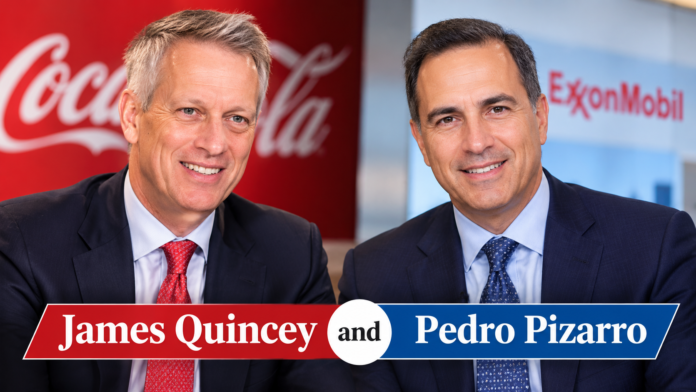
James Quincey and Pedro Pizarro are two influential business leaders who have built their careers by managing complex organisations, making strategic decisions, and guiding major companies through changing business environments. Although they work in different industries, both demonstrate how technical knowledge, business experience, and long-term planning can help executives reach the highest levels of corporate leadership.
James Quincey is best known for his leadership at The Coca-Cola Company, one of the world’s most recognisable beverage businesses. He joined the company in 1996, became its chief executive officer in 2017, and later transitioned to the role of executive chairman in 2026. During his time as CEO, he helped guide Coca-Cola’s international operations, expand its beverage portfolio, and respond to changing consumer preferences. The Coca-Cola Company
Pedro Pizarro, meanwhile, is the president and CEO of Edison International, the parent company of Southern California Edison. His career combines scientific education, management consulting, and extensive experience in the electricity industry. Since becoming CEO in 2016, he has helped oversee a business responsible for important energy infrastructure and services across Southern California. Edison International
While their professional responsibilities are quite different, James Quincey and Pedro Pizarro offer useful examples of leadership in large, established organisations. Understanding their backgrounds, career paths, management priorities, and contributions provides a clearer picture of what it takes to lead major companies in today’s competitive business world.
Who Is James Quincey?
James Quincey and Pedro Pizarro Quincey is a British business executive who spent decades developing his career within Coca-Cola. Born in Britain, he studied electronic engineering at the University of Liverpool before entering the business world. His technical education provided a foundation for analytical thinking, while his later professional experience helped him develop the commercial and leadership skills required to manage international operations.
Quincey joined Coca-Cola in Atlanta in 1996 as director of learning strategy for the company’s Latin America Group. Over time, he moved into increasingly senior positions, gaining experience in several markets and business divisions. He eventually became president of the South Latin division in 2003 and later led the company’s Mexico division from 2005 to 2008. These roles gave him valuable experience in managing teams, understanding local markets, and implementing business strategies across different countries. The Coca-Cola Company
His international experience became especially important as he advanced through Coca-Cola’s leadership structure. He later led the Northwest Europe and Nordics business unit before becoming president of the Europe Group in 2013. In 2015, he became president and chief operating officer, placing him in a strong position to understand the company’s global operations before taking its top executive role. His career demonstrates how a combination of internal experience, international exposure, and strategic decision-making can prepare an executive for senior leadership.
James Quincey’s Leadership at Coca-Cola
James Quincey and Pedro Pizarro Quincey became CEO of Coca-Cola in May 2017 and was elected chairman of the board in 2019. His appointment came at a time when the beverage industry was evolving, with consumers showing growing interest in different drinks, lower-sugar products, and more varied beverage choices. Coca-Cola needed to protect its established brands while adapting to these changing preferences.
One of Quincey’s priorities was to strengthen Coca-Cola’s position as a broader beverage company rather than relying exclusively on its traditional flagship soft drink. Under his leadership, the company continued developing its portfolio across categories and expanding its range of products. This approach helped Coca-Cola respond to consumers whose preferences increasingly extended beyond conventional carbonated beverages. The company’s strategy also focused on marketing, innovation, and making its operating model more responsive to changing market conditions. The Coca-Cola Company
Another important aspect of his tenure was the company’s digital transformation. Businesses increasingly use data, digital marketing, and technology to understand customer behaviour and improve operations. Quincey supported efforts to modernise Coca-Cola’s marketing and organisational structure while maintaining its global brand identity. Leading a company with operations and distribution relationships around the world requires balancing central strategy with local market needs, making this a significant management challenge.
Quincey also led Coca-Cola through the COVID-19 pandemic, a period that disrupted restaurants, entertainment venues, travel, and other channels through which beverages are sold. The experience highlighted the importance of adapting to sudden changes in consumer behaviour and maintaining business resilience. In December 2025, Coca-Cola announced that Henrique Braun would succeed Quincey as CEO, effective March 31, 2026, while Quincey would continue as executive chairman. The Coca-Cola Company
Who Is Pedro Pizarro?
Pedro J. Pizarro is an American business executive whose career combines scientific training, management consulting, and leadership in the energy sector. He serves as president and CEO of Edison International, which oversees Southern California Edison and other energy-related operations. His work places him at the intersection of business management, public infrastructure, technology, and energy policy.
Pizarro earned a bachelor’s degree in chemistry from Harvard University and a PhD in chemistry from the California Institute of Technology, commonly known as Caltech. His academic background reflects a strong foundation in scientific research and analytical problem-solving. Although his career ultimately developed in corporate management rather than laboratory science, these skills remain relevant to an industry that depends on technical expertise, complex systems, and long-term planning. Edison International
Before joining Edison International, Pizarro worked at McKinsey & Company in Los Angeles as a senior engagement manager. His consulting work included corporate strategy, mergers and acquisitions, operational improvements, and organisational issues for clients in sectors such as energy, technology, engineering services, and banking. He joined Edison International in 1999 and moved to Southern California Edison in 2001, gradually taking on more senior responsibilities. This combination of consulting experience and internal industry knowledge helped prepare him for executive leadership. Edison International
Pedro Pizarro’s Leadership at Edison International
Pedro Pizarro became president of Edison International in May 2016 and was appointed CEO in October of that year. His leadership involves overseeing a company operating in a highly regulated industry where reliability, customer affordability, infrastructure investment, and public safety are essential. Unlike consumer businesses, an electric utility must plan for long-term infrastructure needs while responding to immediate service demands and evolving government requirements. (edison.com)
One of Pizarro’s central responsibilities is guiding the company’s approach to a changing energy landscape. Electricity demand, renewable energy development, electric vehicles, and advances in energy technology are reshaping how utilities operate. Meeting these demands requires investment in power infrastructure, careful financial planning, and coordination with regulators, communities, and energy suppliers. His scientific background and consulting experience provide relevant foundations for understanding these interconnected challenges.
Another major priority is wildfire prevention and recovery. California’s electricity providers face significant challenges because of dry conditions, strong winds, and the potential for electrical equipment to contribute to fires. Edison International and its subsidiary Southern California Edison have faced scrutiny over wildfire risks, including the investigation into the January 2025 Eaton Fire. In September 2026, Reuters reported that Pizarro was urging California leaders to establish a clearer framework for wildfire liability and compensation. The issue illustrates the difficult balance between public safety, compensation for affected communities, utility finances, and affordable electricity. (Reuters)
Pizarro’s leadership therefore involves more than managing company performance. It also requires addressing public concerns, supporting infrastructure resilience, and working with policymakers on issues that affect customers and communities. The decisions made under his leadership can influence the company’s long-term financial stability as well as the reliability of essential electricity services.
James Quincey and Pedro Pizarro: Key Differences
Although James Quincey and Pedro Pizarro are both experienced corporate executives, their professional backgrounds and responsibilities differ in several important ways. Quincey built his career in the global beverage industry, where brand recognition, consumer preferences, product innovation, and distribution networks play major roles. Pizarro developed his career in energy, where infrastructure reliability, safety, regulation, and capital-intensive operations are central concerns.
Their educational backgrounds also reflect different paths into executive leadership. Quincey studied electronic engineering at the University of Liverpool and developed his business experience through international roles at Coca-Cola. Pizarro earned a chemistry degree from Harvard and a doctorate from Caltech before working in management consulting and the electricity industry. Both demonstrate that executive leadership can emerge from technical education combined with practical business experience.
Their approaches to business strategy must also account for the markets in which they operate. Coca-Cola competes in a global consumer marketplace where companies must respond to changing tastes, marketing trends, and competition. Edison International operates within a regulated utility environment, where infrastructure investments, public safety, government policy, and customer rates can significantly influence business decisions.
Despite these differences, both executives need strong strategic planning, effective communication, and the ability to manage complex organisations. Their careers demonstrate that successful leadership is not limited to one academic background or industry. Instead, it depends on understanding a company’s responsibilities, evaluating risks, and making decisions that support long-term performance.
James Quincey and Pedro Pizarro’s Approach to Business Strategy
Strategic planning is an essential part of running a large organisation. For James Quincey and Pedro Pizarro Quincey, this meant helping Coca-Cola adapt to changing consumer preferences while maintaining the strength of its established brands. The company needed to keep its core products relevant while exploring opportunities in other beverage categories, modernising its marketing, and improving the way it operated across international markets.
Pedro Pizarro’s strategic responsibilities are different because Edison International must manage essential energy infrastructure. Long-term planning includes assessing electricity demand, strengthening the grid, managing financial risks, and supporting the transition toward cleaner energy. Decisions often require substantial capital investment and coordination with regulators and local communities. The company must also consider the effect of its decisions on customer affordability and system reliability.
Both executives also need to manage uncertainty. Consumer markets can change quickly when preferences shift or competitors introduce new products. Energy businesses face different uncertainties, including extreme weather, regulatory changes, technology costs, and infrastructure risks. Effective leaders must evaluate these factors without losing sight of their organisations’ long-term goals.
Their careers highlight the importance of adapting strategy to the needs of the business. A successful approach for a global beverage company cannot simply be copied by an electric utility. Strong leadership requires recognising the differences between industries and developing solutions that suit each organisation’s operational realities.
Professional Achievements and Corporate Responsibilities
James Quincey and Pedro Pizarro Quincey’s most significant professional achievement was leading Coca-Cola as CEO for nearly nine years. During his tenure, the company continued expanding its broader beverage portfolio and adapting its marketing and operating model. Coca-Cola’s official succession announcement credited his leadership with adding more than ten additional billion-dollar brands to its portfolio and advancing its transformation into a total beverage company. (The Coca-Cola Company)
His move to executive chairman in March 2026 marked a new phase in his corporate career. In this position, he remains involved in the company’s board leadership while Henrique Braun assumes the CEO role. This transition illustrates an important feature of corporate governance: separating executive management from board leadership can help clarify responsibilities while allowing experienced leaders to contribute to a company’s longer-term direction.
Pedro Pizarro’s professional achievements include leading Edison International and serving in several senior positions across its businesses. He has also held leadership and board roles in the broader energy and technology sectors. His service with organisations such as the Edison Electric Institute and his position on the board of 3M demonstrate the wider responsibilities that experienced executives may take on beyond their primary companies. (Edison International)
However, assessing executive achievements requires looking beyond titles and professional recognition. Business leaders are also accountable for the consequences of their decisions, the performance of their organisations, and their relationships with employees, customers, investors, and communities. Quincey’s legacy is connected to Coca-Cola’s brand and business strategy, while Pizarro’s leadership is closely tied to the performance, resilience, and public responsibilities of an essential energy provider.
What Can Business Professionals Learn From James Quincey and Pedro Pizarro?
One important lesson from both careers is the value of continuous professional development. Quincey spent decades moving through different roles within Coca-Cola before becoming CEO. His experience across Latin America, Europe, and global operations helped him understand the challenges of running a multinational business. Professionals can learn from this example by seeking responsibilities that broaden their knowledge rather than focusing exclusively on one narrow area.
Pizarro’s career demonstrates the value of combining technical knowledge with business management skills. His scientific education, consulting experience, and progression through the energy industry provided different perspectives on complex organisational problems. Professionals working in technical fields can benefit from developing communication, financial, strategic, and leadership skills alongside their specialist knowledge.
A third lesson is that leadership requires adaptability. Quincey faced changes in consumer behaviour, competition, and marketing technology. Pizarro must navigate evolving energy needs, infrastructure challenges, regulatory requirements, and environmental risks. Both careers show why executives need to keep learning and adjust their strategies when circumstances change.
Finally, both leaders demonstrate the importance of understanding responsibility. Running a large corporation means making decisions that affect many people, not simply meeting financial targets. Effective executives must consider customers, employees, investors, regulators, and the communities connected to their businesses. Building trust and managing competing priorities are essential parts of sustainable leadership.
Frequently Asked Questions About James Quincey and Pedro Pizarro
1. Who is James Quincey?
James Quincey and Pedro Pizarro Quincey is a British business executive best known for his leadership at The Coca-Cola Company. He became CEO in 2017, was elected chairman in 2019, and transitioned to executive chairman in March 2026 after Henrique Braun succeeded him as CEO.
2. Who is Pedro Pizarro?
Pedro J. Pizarro is the president and CEO of Edison International, the parent company of Southern California Edison. He has worked in the energy industry since joining Edison International in 1999 and became CEO in October 2016.
3. Are James Quincey and Pedro Pizarro connected professionally?
Both are senior executives of major publicly traded companies, but they lead different organisations in separate industries. Quincey is associated with Coca-Cola’s beverage business, while Pizarro leads Edison International’s energy-related operations. There is no established evidence that they have a direct professional partnership.
4. What did James Quincey study?
James Quincey and Pedro Pizarro Quincey earned a bachelor’s degree in electronic engineering from the University of Liverpool in Britain. He subsequently built his business career through strategy consulting and several international leadership positions at Coca-Cola.
5. What did Pedro Pizarro study?
Pedro Pizarro earned a bachelor’s degree in chemistry from Harvard University and a PhD in chemistry from the California Institute of Technology. Before becoming an energy industry executive, he worked as a senior engagement manager at McKinsey & Company.
6. What challenges does Pedro Pizarro face as Edison International’s CEO?
His responsibilities include maintaining reliable electricity service, managing infrastructure investments, addressing wildfire risks, supporting the development of cleaner energy, and balancing financial stability with customer affordability. Wildfire liability and community recovery have also become significant issues for the company.
7. What is James Quincey’s current role?
As of October 2026, James Quincey and Pedro Pizarro Quincey serves as executive chairman of The Coca-Cola Company. Henrique Braun succeeded him as CEO effective March 31, 2026, while Quincey continued in his board leadership role.
Conclusion
James Quincey and Pedro Pizarro represent two different but valuable examples of modern corporate leadership. Quincey’s career at Coca-Cola demonstrates the importance of international experience, brand development, consumer understanding, and adapting a global business to changing market conditions. Pizarro’s work at Edison International highlights the importance of technical knowledge, infrastructure planning, risk management, and public accountability.
Their professional journeys also show that there is no single route to executive leadership. Quincey combined an engineering education with decades of experience in the beverage industry, while Pizarro brought together scientific research, management consulting, and energy sector expertise. Both developed the knowledge and decision-making skills needed to guide complex organisations.
Ultimately, the careers of James Quincey and Pedro Pizarro offer useful lessons for aspiring business leaders. Long-term success requires more than professional qualifications or a senior job title. It depends on sound judgment, the ability to adapt, an understanding of industry-specific challenges, and a willingness to accept responsibility for important decisions. Their experiences provide a meaningful perspective on how leadership works across two very different sectors of the global economy.
You May Also Read: Cal Henderson and Ryan Lance